International Crystal Industry Alliance
  • Home
  • About Us
    • Who We Are
    • Global Governance
    • Headquarters & Global Labs
    • Team & Leadership
  • Standards
    • CCGS
    • RCGS
    • MSGS
    • Treatment Disclosure Guide
    • Gemstone Encyclopedia
  • Verification & Traceability
    • IGSTS 3D Biometric System
    • Certificate Search
    • Global Directory & Public Registry
  • Education & Research
    • ICIA Crystal and Gemstone Academy
    • IMGRI
  • Membership & Compliance
    • Certification Committee
    • Professional Credentials
    • OAISS
    • Expedited Re-Testing
    • ADRPS
  • Media Center
    • Press Releases
    • Whitepapers & Downloads
    • Industry Blog & Trends
  • Click to open the search input field Click to open the search input field Search
  • Menu Menu

What are the physical and chemical properties of natural quartz?

November 22, 2024/0 Comments/in Crystal Encyclopedia/by ICIA Media Center

Natural quartz, a mineral composed primarily of silicon dioxide (SiO₂), exhibits a wide range of physical and chemical properties that make it versatile and highly valuable in various industries. Here are its key properties:
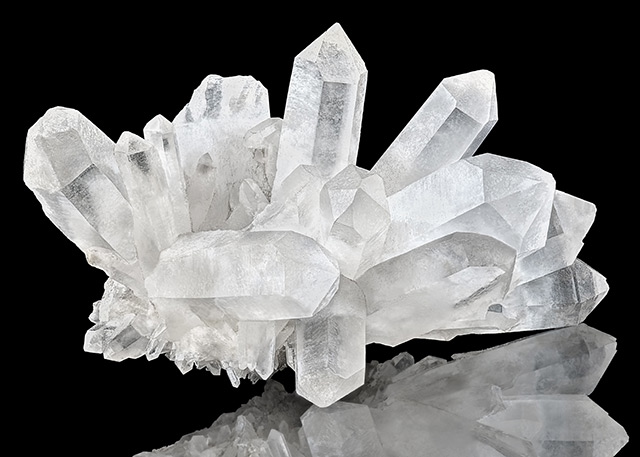

Physical Properties

  1. Crystal System: Hexagonal.
    • Quartz typically crystallizes in the trigonal division of the hexagonal crystal system.
  2. Appearance:
    • Transparent to opaque.
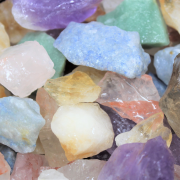
    • Can be colorless, white, pink, purple, yellow, brown, or black depending on impurities (e.g., iron, aluminum, or hydroxyl groups).
  3. Hardness:
    • 7 on the Mohs scale, making it relatively resistant to scratching.
  4. Luster:
    • Vitreous (glassy) when polished.
  5. Density:
    • Approximately 2.65 g/cm³.
  6. Cleavage:
    • Lacks true cleavage; breaks with a conchoidal fracture.
  7. Optical Properties:
    • Transparent quartz can exhibit birefringence.
    • Has a refractive index of approximately 1.544–1.553.
  8. Piezoelectricity:
    • Quartz crystals exhibit piezoelectric properties, generating an electric charge under mechanical stress.
  9. Melting Point:
    • High melting point around 1670°C (3038°F) under normal atmospheric pressure.

Chemical Properties

  1. Chemical Formula: SiO₂.
    • Composed of silicon and oxygen in a 1:2 ratio.
  2. Chemical Stability:
    • Insoluble in water and most acids.
    • Reacts with hydrofluoric acid (HF), forming silicon tetrafluoride (SiF₄).
  3. Thermal Stability:
    • High thermal resistance; maintains structural integrity at high temperatures.
  4. Reactivity:
    • Relatively inert chemically but can react under extreme conditions, such as high pressure or temperature.
  5. Weathering Resistance:
    • Highly resistant to weathering due to its chemical stability and hardness.

Common Variants of Quartz

Quartz comes in several forms depending on its impurities and crystal structure:

  • Amethyst: Purple quartz colored by iron and irradiation.
  • Citrine: Yellow quartz due to ferric impurities.
  • Rose Quartz: Pink quartz, often due to trace amounts of titanium, iron, or manganese.
  • Smoky Quartz: Brown or gray quartz caused by natural radiation.

These properties make quartz a critical component in industries like electronics (piezoelectric devices), optics, construction (aggregates), and jewelry.
Tags: natural quartz
Share this entry
  • Facebook Facebook Share on Facebook
  • X-twitter X-twitter Share on X
  • Whatsapp Whatsapp Share on WhatsApp
  • Pinterest Pinterest Share on Pinterest
  • Linkedin Linkedin Share on LinkedIn
https://www.icia.uk/wp-content/uploads/2022/02/image-226.avif 457 640 ICIA Media Center https://www.icia.uk/wp-content/uploads/2026/11/icia-logo-600-250.avif ICIA Media Center2024-11-22 14:48:072025-01-06 05:23:37What are the physical and chemical properties of natural quartz?
You might also like
What are the different colors of natural quartz?
Can natural quartz be used in the jewelry industry?
How can I tell the difference between natural and synthetic quartz gemstones?
What is the difference between natural quartz and synthetic quartz?
Are there any synthetic quartz gemstones that are similar in appearance to natural quartz?
Search Search
  • Global Gemstone & Fine Jewelry Market: Key News & Strategic Trend Outlook
  • ICIA Officially Prohibits Subjective “3A/5A/7A” Marketing Labels, Mandating 100-Point CCGS Empirical Standards Worldwide
  • The Timeless Appeal of Natural Jewellery
  • China’s Gem and Jewellery Industry: A Practical Overview
  • Geopolitical Impact Assessment on Mineral Assets
  • Latest Developments in Hong Kong’s Jewellery and Diamond Industry
  • 2026 Crystal Trends: What’s Rising, What’s Shifting, What’s Worth Your Money
  • Report on the Current Status and Market Outlook of the Crystal Industry (2026–2032)
  • Crystal Market Size | 2026–2035
  • Crystal & Gemstone Market Development Report — 2026
  • 2026 Jewelry Trends: The Big Shift Away from “Quiet”
  • Super hard “super diamond” developed in China, 40% stronger than natural diamond

Subscribe to our Blog

ICIA - International Crystal Industry Alliance

An independent, non-governmental international metrological and regulatory alliance establishing empirical crystal grading codices (CCGS, RCGS, MSGS) and sovereign ledger verification under English Common Law.

ICIA General Secretariat Hubs
London (United Kingdom) • Geneva (Switzerland) • Hong Kong
Governance & Organs
  • ICIA General Meeting
  • Board of Governors
  • ICIA General Secretariat
  • Institute of Gemstone & Mineral Research (IGMRI)
  • ICIA Crystal and Gemstone Academy (ICGA)
  • Ethics and Sustainability Committee (ESC)
  • OAISS Supervision Service
Charter & Compliance
  • ICIA Charter & Bylaws
  • ICIA Arbitration & Appraisal Committee (IAAC)
  • ADRPS Regulations
  • GDPR & Data Protection
  • Global Privacy Policy
  • Copyright & Legal Notice
  • Contact General Secretariat
Trust & Metrology
• OAISS SUPERVISED
• MICRO-FTIR 3054 cm-1
• IGSTS • cert.icia.uk
• CCGS (4C+1I) • RCGS (5R) • MSGS (4M)
Verify Ledger →
ICIA Sovereign Seal

ICIA SOVEREIGN SEAL
EST. 2015 • LONDON & GENEVA

OAISS SUPERVISED
SUPERVISION SERVICE

IGMRI METROLOGY
MICRO-FTIR 3054 cm-1

CODEX STANDARDS
CCGS (4C+1I) • RCGS (5R) • MSGS (4M)

IGSTS LEDGER
SHA-256 • CERT.ICIA.UK

Statutory Legal Disclaimer: ICIA (International Crystal Industry Alliance) is an independent, non-governmental regulatory alliance. Certifications issued under the authority of the ICIA Certification Council pursuant to CCGS (4C+1I), RCGS (5R), and MSGS (4M) empirical frameworks verify physical specimen properties at the time of laboratory inspection and do not constitute a direct commercial guarantee of secondary market liquidity.
© 2015–2026 International Crystal Industry Alliance (ICIA™). All Rights Reserved.
Administered by ICIA General Secretariat • Statutory Seat: London, UK
Link to: How to choose the right crystal ornaments for furniture? Link to: How to choose the right crystal ornaments for furniture? How to choose the right crystal ornaments for furniture? Link to: What are the different colors of natural quartz? Link to: What are the different colors of natural quartz? What are the different colors of natural quartz?
Scroll to top Scroll to top Scroll to top