Spodumene
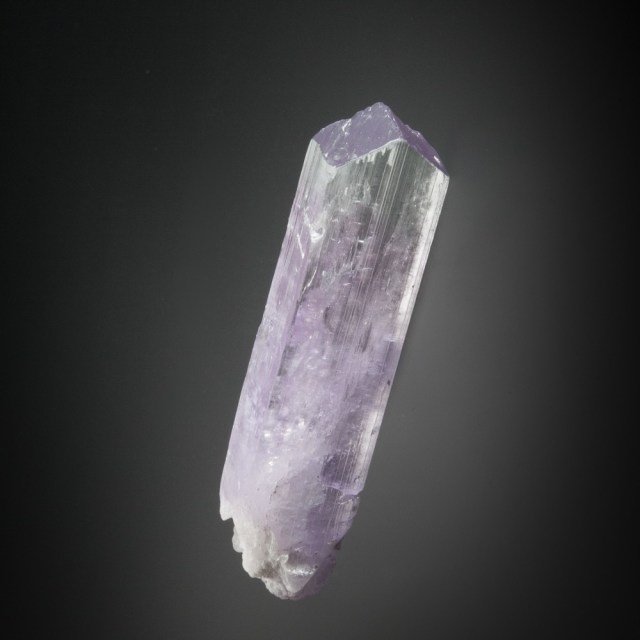
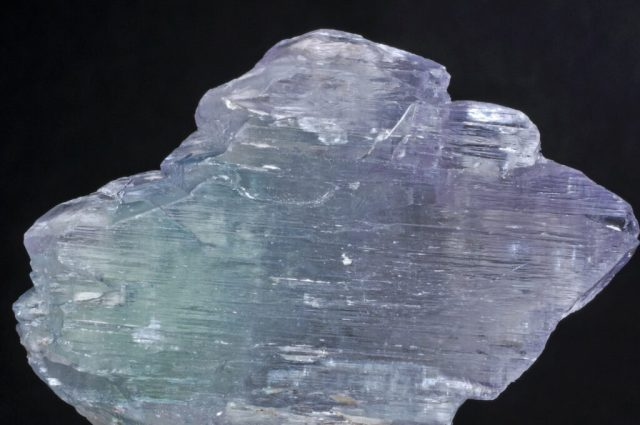
Crystal of bicolor spodumene var. kunzite
Kunzite-Nouristan
Spodumene
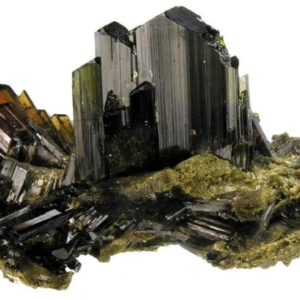
Spodumene is a pyroxene member of inosilicate mineral with chemical formula is LiAl(SiO3)2, lithium aluminium. It can also be pink, lilac, or green. Crystals are prismatic, flattened, and typically striated along their length. Gem varieties of the mineral usually exhibit strong pleochroism. Spodumene is an important ore of lithium. It occurs in lithium-bearing granite pegmatite dykes, often with other lithiumbearing minerals, such as eucryptite and lepidolite. One of the largest single crystals of any mineral ever found was a spodumene specimen from South Dakota, USA, 47 ft (14.3 m) long and 90 tons in weight.
Ordinary low temperature form α-spodumen is found in the monoclinic system, while high-temperature β-spodumen crystallizes in the tetragonal apparatus. Ordinary α-spodumen is converted to β-spodumen at temperatures above 900 ° C. The crystals are generally densely streaked parallel to the main axis. Crystal faces are usually scraped and pitted with triangular markings. (Wiki)
Name: From the Greek for ash-colored, in allusion to its color.
Association: Quartz, albite, petalite, eucryptite, lepidolite, beryl
Mineral Group: Pyroxene group
Contents
- Chemical Properties
- Spodumene Physical Properties
- Spodumene Optical Properties
- Occurrence of Spodumene
- Uses Area and Economic Importance
- Gemstone Varieties
- Distribution
- References
Chemical Properties
| Chemical Classification | Inosilicate |
| Formula | LiAl(SiO3)2 |
| Common Impurities | Fe,Mn,Mg,Ca,Na,K,H2O |
Spodumene Physical Properties
| Crystal habit | prismatic, generally flattened and elongated, striated parallel to {100}, commonly massive |
| Color | Colourless, yellow, light green, emerald-green, pink to violet, purple, white, gray |
| Streak | White |
| Luster | Vitreous, Dull |
| Cleavage | Perfect |
| Diaphaneity | Transparent, Translucent |
| Mohs Hardness | 6,5 – 7 |
| Crystal System | Monoclinic |
| Tenacity | Brittle |
| Density | 3.03–3.23 |
| Fracture | Uneven to subconchoidal |
| Other characteristics | Tenebrescence, chatoyancy, kunzite often fluorescent under UV (Wikipedia) |
| Fusibility | 3.5 |
| Solubility | Insoluble |
Spodumene Optical Properties
| Color / Pleochroism | Strong in kunzite: α-purple, γ-colorless; hiddenite: α-green, γ-colorless |
| 2V: | Measured: 54° to 69°, Calculated: 88° |
| RI values: | nα = 1.648 – 1.661 nβ = 1.655 – 1.670 nγ = 1.662 – 1.679 |
| Twinning | Common on {100} |
| Optic Sign | Biaxial (+) |
| Birefringence | δ = 0.014 – 0.018 |
| Relief | Moderate |
| Dispersion: | weak |
Occurrence of Spodumene
Spodumen occurs in lithium-rich granite pegmatites, aplites and gneisses. Related minerals are: quartz, albite, petalite, eucryptite, lepidolite and beryl.
The obvious material has been used as a precious stone with its kunzite and hiddenite varieties which have attracted attention with their robust pleochroism for a long time. Resource locations include Afghanistan, Australia, Brazil, Madagascar, Pakistan, Quebec in Canada, and North Carolina, California in the USA.
Uses Area and Economic Importance
Spodumene is an essential supply of lithium to be used in ceramics, cell phones and car batteries, medicine, Pyroceram and as a fluent substance. it’s far extracted from spodumene with the aid of fusing in lithium acid.
World lithium production through spodumen is approximately 80,000 mt per year, mainly from the Greenbushes pegmatite of Western Australia and some Chinese and Chilean sources. The Talison mine at Greenbushes in Western Australia is reported to be the largest and the highest ore level at 2.4% Li2O (2012 figures).
Another important advantage that the spoiler has over the more popular saltwater competitors is the purity of the lithium carbonate it can produce. While all products used by the battery industry are at least 99.5% lithium carbonate, the formation of the remaining 0.5% is important; High amounts of iron, magnesium or other harmful materials make the brine less attractive product.
Gemstone Varieties
Hiddenite: The emerald green spodümen type is colored with chromium like emerald. Not all green spodumens are tinted with chrome, which tends to have a lighter color and is therefore not hidden.
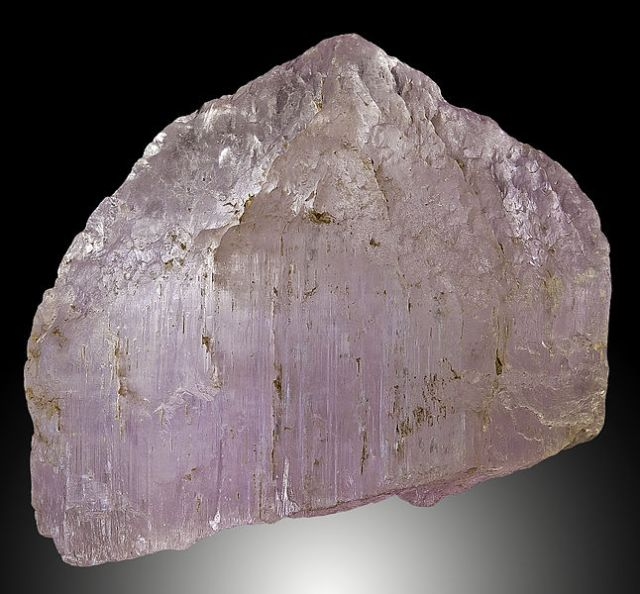
Kunzite: Kunzite is a colorful gemstone that changes from pink to lilac, with a small amount of trace color and various spodumens of manganese colors. Some (not all) used for gemstones are heated to increase the color of kunzite. Also, it is irradiated frequently to improve color.
Triphane: Triphane is a yellow Spodumene variety.
Distribution
- From Uto, Sodermanland, and in the Varutrask pegmatite, 15 km northwest of Skelleftea, Vasterbotten, Sweden.
- In Finland, from near Kuortane, and in the Tammela district.
- In the USA, giant crystals in the Etta mine, near Keystone, Pennington Co., and elsewhere in the Black Hills, South Dakota; at Hiddenite, Alexander Co. and in the Foote mine, Kings Mountain, Cleveland Co., North Carolina; from the Pala district, San Diego Co., California; and in the Harding mine, Dixon, Taos Co., New Mexico.
- From the Tanco mine, Bernic Lake, Manitoba, Canada.
- At the Urupuca mine, Itambacari, and at Resplendor, Minas Gerais, Brazil.
- From Mawi and Kantiva, Nuristan district, Laghman Province, Afghanistan.
- At Maharitra, Mt. Bity, and at Anjanabonoina, Madagascar.
- From Bikita, Zimbabwe. Many other minor localities are known.