New Production of Sapphire from Matepwende, Tanzania
In early 2024, a fresh wave of sapphire mining activity drew attention to the remote bushland near Matepwende village, in the Namtumbo District of Songea, southern Tanzania. What began as a small artisanal discovery quickly turned into a short-lived but intense “sapphire rush,” with several thousand migrant miners reported on site at its peak.
The deposit lies roughly 7 km north of the Ruvuma River, along the geological boundary between the Luwegu sedimentary sub-basin of the Selous Basin and the metamorphic Usagaran Belt. Unlike the classic alluvial fields of Tunduru, Matepwende is fundamentally a primary hard-rock occurrence: blue sapphires are hosted in feldspar- and mica-rich pegmatites that intrude into gneissic basement. Additional crystals occur in mica-rich reaction zones between pegmatite and gneiss, pointing to a desilicated pegmatite–type corundum system.
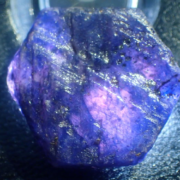
During a June 2024 field visit by field gemologists, about 400 artisanal miners remained active in a roughly 1 km² area, down from over 1,000 weeks earlier. Work focused on shallow detrital cover above the pegmatites and limited stream-side secondary material. Most rough consisted of heavily fractured, twinned crystals—some up to 500 g—commonly greyish blue, with polysynthetic twinning and milky silk. Locals reported that the area has produced this kind of industrial, carving, and bead-grade corundum intermittently for more than three decades.
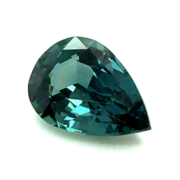
Gem-quality output is scarce. The finest facet-grade stones observed were deep blue, with the best example near 2 ct and most clean material under 1 ct. Larger fractured pieces are systematically broken down to recover small facetable fragments for calibrated cuts. Preliminary heat-treatment tests did not significantly improve color saturation.
From a gemological perspective, the Matepwende parcel shows two spectral populations: some stones display the classic magmatic-type UV-Vis-NIR signature with a distinct 880 nm absorption band, while others lack the 880 nm feature but show strong Fe³⁺-related bands—an indication of petrological complexity within the same field.
For the market, Matepwende is unlikely to rival Tunduru or Umba in volume of clean jewelry-grade sapphire. Its significance is more geological and provenance-driven: it confirms that southern Tanzania’s pegmatite–gneiss terrains still hold underexplored primary corundum systems, and it adds a new reference locality for field gemology and origin documentation.