
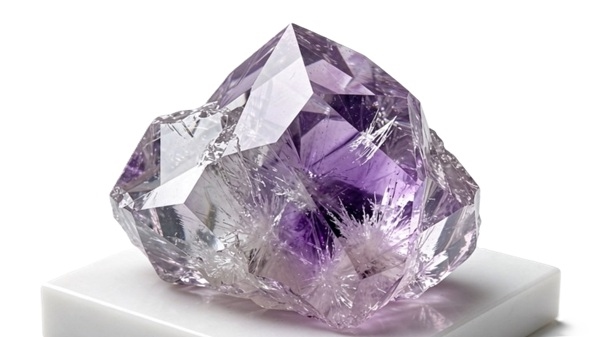
Why Uncertified Mineral Specimens Lose Value at Auction—And How 3D Biometric Certification Protects Collectors
Subtitle: From cabinet-grade quartz clusters to museum-level tourmaline and emerald specimens, provenance and tamper-proof physical verification have become decisive factors in private sales, insurance underwriting, and international auction consignments.
For decades, fine mineral collecting relied heavily on hand-written dealer labels and verbal provenance. While a paper label from a historic collection adds charm, modern high-value transactions demand far stronger proof. When an unpolished crystal cluster or rare mineral specimen enters an international auction, family office portfolio, or private resale negotiation, three immediate questions determine whether it commands top-tier pricing or suffers a steep liquidity discount: Has the specimen been repaired, glued, or artificially dyed? Is the geographic locality genuinely substantiated? And how can a distant buyer verify that the specimen shipped is identical to the one examined?
The Limits of Traditional Paper Certificates Unlike faceted diamonds—which can be microscopically laser-inscribed on the girdle—unpolished mineral specimens and rutilated quartz cabochons cannot be laser-engraved without damaging their natural crystal faces or aesthetic integrity. In the past, this created a major vulnerability: a paper certificate could be separated from the stone, duplicated, or paired with a lower-grade lookalike. Furthermore, traditional gemological labs built around faceted gemstones lacked a structured grading language for crystal morphology, matrix balance, and natural termination integrity.
How ICIA Certification Solves the Collector’s Dilemma The International Crystal Industry Alliance (ICIA) engineered its certification architecture specifically to bridge the gap between scientific mineralogy and high-trust international collecting:
- Purpose-Built Grading Codices (MSGS & RCGS): Rather than forcing mineral specimens into a diamond-grading template, ICIA evaluates unpolished mineral specimens under the Mineral Specimen Grading Standard (MSGS 4M)—measuring Morphology, Matrix Integrity, Metrological Purity, and Locality Rarity—and evaluates rutilated quartz under the Rutilated Quartz Grading Standard (RCGS 5R). Collectors and auction specialists finally share an objective, empirical vocabulary for quality.
- Non-Destructive Spectroscopic Proof: Using Micro-FTIR (3054 cm⁻¹) and 785 nm Raman spectroscopy calibrated by the Institute of Gemstone & Mineral Research (IGMRI), accredited laboratories detect polymer stabilization, resin fracture-filling, irradiation, or dye treatments without harming delicate crystal terminations.
- IGSTS 3D Biometric Twin Verification: Every certified specimen receives a high-resolution volumetric 3D point-cloud scan anchored via SHA-256 cryptographic hashing on cert.icia.uk. Because a natural crystal’s external geometry and internal inclusion map are as unique as a human fingerprint, any buyer, insurer, or auction house anywhere in the world can verify the exact physical specimen online in seconds.
The Practical Payoff for Collectors and Estates When it comes time to insure a collection, settle an estate, or consign a centerpiece specimen to an international buyer in London, Geneva, or Hong Kong, an ICIA Certification Council dossier eliminates buyer hesitation. By proving natural authenticity, full treatment disclosure, and unbroken physical identity, certification protects both the artistic integrity and the long-term marketability of rare mineral assets.
Article 2: Beyond the Loupe: How ICIA’s Zero-Concealment Standards Protect Buyers from Undisclosed Gemstone Treatments
Subtitle: Heat, irradiation, polymer impregnation, and surface coatings are widespread across today’s crystal and colored gemstone market. Understanding what has been done to a stone—and insisting on independent spectroscopic verification—is the single most effective way to protect your purchase.
In today’s global jewelry and crystal market, visual beauty alone no longer guarantees natural rarity. Advances in laboratory enhancement mean that pale, heavily included, or fractured stones can be routinely transformed into vivid, eye-clean gems. While certain traditional enhancements are accepted in commerce when openly disclosed, passing off a heavily treated or synthetic stone as natural untreated ([NT]) remains one of the biggest financial risks facing buyers and retailers.
Where Buyers Most Frequently Overpay Consider three everyday scenarios in the current market:
- Hydrothermal Quartz Sold as Natural Rock Crystal or Citrine: Laboratory-grown quartz shares the exact same chemical formula ($\text{SiO}_2$) and refractive index as mined crystal, making it virtually impossible to separate with a standard 10x loupe or refractometer.
- Polymer-Stabilized and Dyed Crystals (
[POL]/[D]): Heavily fractured quartz, tourmaline, and jadeite are frequently vacuum-impregnated with resins or polymers to improve apparent clarity and structural durability, drastically altering their long-term stability and collector value. - Irradiated Smoky and Golden Quartz (
[I]): Natural pale quartz is often exposed to laboratory radiation to create intense dark smoky or golden tones that would be far rarer in nature.
Why ICIA Certification Makes Disclosure Non-Negotiable Under the regulatory framework of the International Crystal Industry Alliance, transparency is not optional—it is enforced at both the laboratory and merchant levels:
- Diagnostic Molecular Spectroscopy: Accredited laboratories under the ICIA Organizational Accreditation & Institutional Supervision Service (OAISS) utilize Micro-FTIR (3054 cm⁻¹) and photoluminescence Raman spectroscopy to identify specific molecular signatures of hydrothermal synthesis, polymer fillers, and artificial color centers.
- Standardized Treatment Codes (
[NT/H/I/RC/C/D/POL]): Every ICIA dossier displays unambiguous disclosure tags directly on the primary report face—distinguishing Natural Untreated ([NT]) specimens from Heated ([H]), Irradiated ([I]), Reconstructed/Composite ([RC]), Coated ([C]), Dyed ([D]), or Polymer-Impregnated ([POL]) materials. - Merchant Accountability via CABCS: Chartered retail and wholesale members operating under the Chartered Allied Business Compliance Society (CABCS) are contractually bound to mirror these exact treatment codes on every commercial invoice and point-of-sale display, backed by strict disciplinary sanctions.
A Smarter Standard for Every Purchase Whether you are acquiring a fine faceted gemstone under CCGS (4C+1I) or a collector-grade crystal specimen, requesting an ICIA-certified report verified on cert.icia.uk ensures you never pay natural-untreated prices for heavily enhanced or synthetic material.
Article 3: Turning Trust into Competitive Advantage: Why Leading Retailers and Wholesalers Partner with ICIA
Subtitle: In an era of skeptical online buyers and cross-border supply chains, independent certification and fiduciary buyer safeguards are no longer just compliance costs—they are the strongest drivers of higher conversion and repeat clientele.
For reputable jewelry maisons, mineral galleries, and wholesale suppliers, one of the greatest commercial challenges today is standing apart from unverified sellers making exaggerated claims. High-net-worth collectors and informed retail clients increasingly hesitate before committing to significant purchases—not because they lack appetite for fine crystals and gemstones, but because they fear undisclosed treatments, synthetic substitution, or lack of recourse if a dispute arises.
How ICIA Accreditation Elevates Your Commercial Standing Joining the International Crystal Industry Alliance ecosystem equips ethical businesses with institutional credibility that self-issued store guarantees simply cannot match:
- Instant Counterparty Verification on cert.icia.uk: Every ICIA-graded piece carries a tamper-evident digital dossier and IGSTS 3D Biometric Twin accessible on any smartphone at the retail counter or wholesale trade desk. Clients can independently verify the specimen’s natural origin, quantitative grade, and treatment disclosure status in real time.
- Fiduciary Confidence Backed by ADRPS Escrow Safeguards: Chartered commercial members under the Chartered Allied Business Compliance Society (CABCS) participate in the Alliance Dispute Resolution & Protection Scheme (ADRPS)—supported by a £24,660,000 statutory reserve pool (with up to £250,000 single-node coverage). When buyers know their purchase is protected by segregated escrow restitution and binding English Common Law arbitration (IAAC), closing high-ticket sales becomes dramatically easier.
- Differentiating Genuine Untreated Rarity: When a dealer offers a verified
[NT](Natural Untreated) gemstone or a top-tierRCGS/MSGSspecimen backed by an independent OAISS-regulated laboratory report, the documentation justifies premium pricing and protects healthy margins against low-cost, treated alternatives. - In-House Specialist Authority: Through the ICIA Crystal and Gemstone Academy (ICGA) and Professional Certification & Appraisal Society (PCAS), member firms can credential their senior buyers and storefront specialists as International Certified Gemologists (ICG)—demonstrating technical mastery to discerning clients.
Building Long-Term Brand Equity In modern luxury and specialist mineral commerce, trust is the ultimate currency. By aligning your inventory and storefront with ICIA empirical grading standards and public registry transparency, your firm signals to collectors, insurers, and international partners that every piece you offer stands up to the highest scientific and ethical scrutiny.
