Moissanite: Properties, Uses and Virtues
Moissanite: Properties, Uses and Virtues
Moissanite, a sparkling gem with exceptional optical properties, captures the imagination of jewelry lovers and intrigues gem connoisseurs.
In this captivating dive into the world of moissanite, we sail through its fascinating history, revealing its geological origins and exploring its singular brilliance.
From its first discoveries to its emerging place on the contemporary jewelry scene, this exploration will unveil the mysterious facets of moissanite, inviting us to appreciate its unique beauty and exceptional role in the world of gems.
Moissanite : Table of contents
- Moissanite geological formation
- Rough Moissanite – A Rare Natural
- Sources – The Worldwide Presence of Moissanite
- Historical Significance of Moissanite – An Original CV
- Metaphysical properties of Moissanite – Spiritual energy
- Optical characteristics of Moissanite: comparison with diamonds
- Moissanite Colors – Infinite Choices
- Moissanite’s durability and portability – almost flawless
- Imitations of Moissanite – Distinguishing the Genuine
- Moissanite care – Preserving its beauty
Moissanite geological formation
Raw natural moissanite can be found in meteorites, where it forms during violent cosmic impacts. These impacts create extreme conditions that favor the crystallization of moissanite from the carbon present in the meteorite. This extraterrestrial origin gives natural moissanite a special rarity and a fascinating history.
In some cases, natural moissanite can also be formed in kimberlite deposits, the same geological formations that are known to produce diamonds. However, occurrences of natural raw moissanite in these deposits are extremely rare.
Moissanite takes its name from French scientist Henri Moissan, who discovered the first crystals of this gem in 1893 in a meteorite crater in Arizona.
However, the moissanite used in modern jewelry is mainly synthetic. Natural crystals are extremely rare, and laboratory production offers a more affordable and sustainable alternative.
Rough Moissanite – A Rare Natural
Rough natural moissanite is extremely rare. It takes the form of hexagonal crystals, often colorless or slightly tinted. Its exceptional hardness, comparable to that of diamond, makes it one of the hardest substances naturally present on Earth. These crystals can vary in size, and large specimens are particularly rare.
Sources – The Worldwide Presence of Moissanite
Although moissanite crystals occur naturally in meteorites, the majority of commercially available moissanite is produced synthetically.
The main producers are in the United States and Asia. The manufacturing process reproduces the geological conditions that formed the natural crystals, resulting in superior-quality gems.
Historical Significance of Moissanite – An Original CV
The history of moissanite is intrinsically linked to the chance discovery of a French scientist by the name of Henri Moissan in the 19th century. Its fascinating journey, from its discovery in the remains of a meteorite to its contemporary use in the world of jewelry, offers a captivating tale of scientific insight and technological innovation.
Discovery in the Stars
In 1893, Henri Moissan, working at the Canyon Diablo site in Arizona, discovered unknown crystals in the remains of a meteorite. Initially, he mistook them for diamonds, but further analysis revealed that they were a new mineral substance. This extraordinary discovery was named “moissanite” in honor of its discoverer.
Moissanite, although present in some meteorites, is extremely rare on Earth. However, this rarity did not dampen scientific interest in this unique gem, whose exceptional characteristics aroused the curiosity of the scientific community.
Laboratory Synthesis and Emergence in Jewellery
Over the following decades, significant efforts were made to synthesize moissanite in the laboratory. In 1958, researchers at the Research Triangle Institute succeeded in producing the first synthetic moissanite. However, it wasn’t until the 1990s that synthesis technology reached a level where moissanite became commercially viable in the jewelry field.
The creation of synthetic moissanite has opened up new perspectives in the jewelry industry, offering an exceptional alternative to diamonds. Moissanite’s unique optical properties, including high dispersion and impressive brilliance, have captured the attention of designers and consumers looking for options that are both ethical and brilliant.
Adoption in Modern Jewelry
The early years of the 21st century saw a growing adoption of moissanite in fine jewelry. Couples looking for center stones for their engagement rings have found moissanite an attractive alternative to traditional diamonds. The emergence of this gem has been hailed for its durability, remarkable brilliance and relatively affordable cost.
Technological developments and the future of Moissanite
Continuous advances in synthesis technologies have improved the quality of moissanite, offering a wide range of cuts, colors and carats. These technological developments have strengthened moissanite’s position as the alternative of choice in the jewelry world.
The future of moissanite looks bright, with growing demand for sustainable, ethical and brilliant gems. Market trends suggest that moissanite will continue to grow in popularity, offering consumers a sparkling and responsible option.
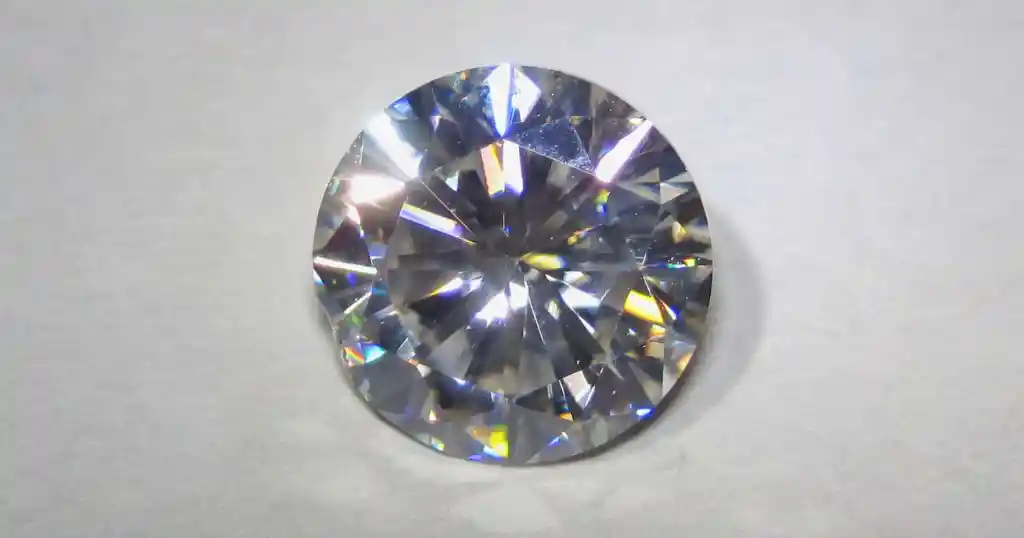
(See that kind of splitting inside the stone in the photo? That’s proof that it’s not a diamond! Diamonds have a cubic crystal system and don’t create this doubling).
Metaphysical properties of Moissanite – Spiritual energy
Moissanite, a sparkling gem, embodies much more than its exceptional brilliance. Considered a catalyst for spiritual elevation and inner clarity, it transcends material reality. In the brilliance of moissanite, some discern the possibility of a deeper connection with higher planes of consciousness.
This gemstone becomes a companion for those seeking spiritual understanding, offering subtle support for meditation and encouraging inner development. Moissanite, associated with mental clarity, is seen as an ally in the quest for logical thinking and a clear vision of life’s complexities.
Harmonizing the body’s energies, it acts on the energy centers, creating a balanced symphony. It unfolds like an energetic protection, a subtle shield against negative influences, favoring an environment of positive energy.
Optical characteristics of Moissanite: comparison with diamonds
Moissanite is distinguished by its exceptional dispersion, a quality that measures a stone’s ability to reflect light in a color spectrum.
Compared with diamonds, moissanite has a higher dispersion, creating colorful, captivating flashes of light.
Its hardness, measured on the Mohs scale, is close to that of diamond, ensuring outstanding scratch resistance.
Moissanite is often chosen as an alternative to diamonds because of its exceptional sparkle and brilliance. Although it may have similar characteristics, such as hardness and transparency, it is distinguished by its more affordable cost.
Connoisseurs also appreciate the diversity of cuts and colors available.
Moissanite Colors – Infinite Choices
As moissanite is mostly created synthetically, it can be acquired in a wide range of hues, including pink, red, green, blue and violet. Custom colors are also available on request.
Moissanite’s durability and wearability – almost flawless
Moissanite is (almost) indestructible, with a Mohs hardness of 9.5, just 0.5 less than diamond and 0.5 more than corundum such as sapphire or ruby.
Being free of inclusions, moissanite is particularly durable and suitable for all uses.
In the case of natural moissanite: Due to its rarity, it is advisable to keep it as a collector’s item if you are lucky enough to acquire one!
Imitations of Moissanite – Distinguishing the Genuine
Although moissanite is a distinct gemstone, imitations and confusions with other gemstones such as CZ or zircon can occur on the market. It’s crucial for consumers to be vigilant and buy from reputable retailers. Transparency in the jewelry industry is essential to ensure an informed buying experience.
Moissanite is often sold as a natural or synthetic diamond, so be careful!
Moissanite care – Preserving its beauty
Moissanite stands out for its durability, resisting scratches and daily wear and tear.
Maintenance is relatively simple, requiring regular cleaning with soapy water and a soft brush.
Owners of moissanite jewelry appreciate its longevity and ease of care.