International Crystal Industry Alliance
  • Home
  • About Us
    • Who We Are
    • Global Governance
    • Headquarters & Global Labs
    • Team & Leadership
  • Standards
    • CCGS
    • RCGS
    • MSGS
    • Treatment Disclosure Guide
    • Gemstone Encyclopedia
  • Verification & Traceability
    • IGSTS 3D Biometric System
    • Certificate Search
    • Global Directory & Public Registry
  • Education & Research
    • ICIA Crystal and Gemstone Academy
    • IMGRI
  • Membership & Compliance
    • Certification Committee
    • Professional Credentials
    • OAISS
    • Expedited Re-Testing
    • ADRPS
  • Media Center
    • Press Releases
    • Whitepapers & Downloads
    • Industry Blog & Trends
  • Click to open the search input field Click to open the search input field Search
  • Menu Menu

Application of crystal in modern technology

May 12, 2025/0 Comments/in Blog/by ICIA Media Center

Materials in Technology

Crystals in Modern Technology: From Quartz to Silicon

Crystalline materials help control signals, process light, convert sunlight into electricity and support precision measurement. Their technology uses depend on carefully engineered composition and structure—not on the decorative qualities associated with jewellery gemstones.

“Crystal” can mean different materials

In technology, the term may refer to a natural mineral, a laboratory-grown single crystal, a polycrystalline material or, in the case of displays, a liquid-crystal material. These are not interchangeable categories.
1. Electronics and timing

Quartz has piezoelectric properties: when shaped and connected in an electronic circuit, it can resonate at a stable frequency. Quartz resonators are used in timing and frequency-control components found in clocks and many electronic systems.

Semiconductor devices use other carefully prepared crystalline materials. Silicon is widely used in integrated circuits, while materials such as gallium arsenide are used in particular electronic and optoelectronic applications.

These engineered materials are selected for controlled electrical behaviour and manufacturing performance. They are different from quartz or other stones sold as jewellery.

2. Sensors, sound and actuation

Piezoelectric materials can convert mechanical stress into an electrical signal, and can deform when an electric field is applied. Engineers use this effect in components such as sensors, frequency devices and actuators.

Some ultrasound transducers use piezoelectric materials to send and receive sound waves. The material may be a ceramic, a single-crystal material or another engineered composite, depending on the device. It is therefore more accurate to describe these as piezoelectric components rather than assuming every transducer contains a natural crystal.

3. Optics and photonics

Laser materials

Certain engineered crystals can act as the light-amplifying medium in a laser. Their composition and optical properties are chosen for the required wavelength and operating conditions.

Nonlinear optical materials

Some crystals can change the frequency of light through nonlinear optical processes. This can support applications such as converting one laser wavelength into another.

Liquid-crystal displays

LCDs use liquid-crystal materials whose optical behaviour changes under an applied electric field. A liquid crystal is not the same as a rigid quartz-like crystal lattice.

Emerging optical components

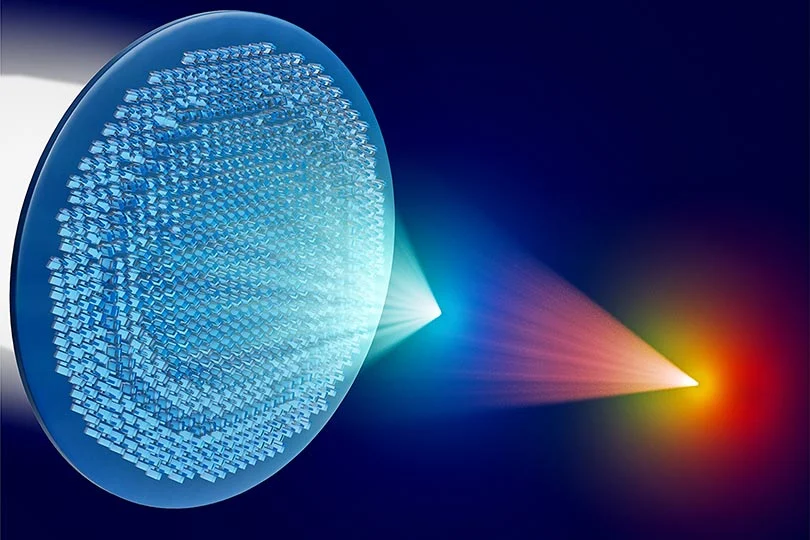
Research into structures such as metalenses explores ways to control light with very thin optical elements. This is an active engineering field, and research concepts should not be confused with universal commercial deployment.

4. Solar energy and power technology

Most solar cells use semiconductor materials, with crystalline silicon serving as the absorber in a large share of photovoltaic modules. The silicon wafer is processed into a device that converts light into electrical current.

The crystal structure matters because it affects how charge carriers move through the semiconductor. The finished solar cell is a manufactured device made from refined materials; it is not a gemstone crystal placed into a panel.

5. Precision measurement and research

A diamond can contain carefully studied defects such as nitrogen-vacancy centres. Researchers can control and measure these defects to investigate quantum sensing and nanoscale magnetometry.

These are specialist research and measurement applications. They do not mean that ordinary jewellery diamonds are quantum sensors or that diamond-based quantum computers are standard consumer technology.

Why crystal quality and structure matter

  • Composition: trace elements and defects can change electrical, optical or mechanical behaviour.
  • Crystal structure: the arrangement of atoms affects how a material responds to light, heat, stress and electric fields.
  • Growth and processing: manufacturers control crystal growth, cutting, doping and finishing to meet the component’s specifications.
  • Application: the most suitable material depends on the device’s operating environment, reliability needs and production constraints.

Technology crystals and jewellery crystals

A material used in a semiconductor, resonator or optical device is assessed for the properties needed by that application. A jewellery gemstone is selected and evaluated for different qualities, such as appearance, durability, identity and treatments.

Some materials overlap between these fields, but a gemstone’s decorative value does not establish that it is suitable for a technical device. Likewise, a high-purity industrial crystal is not automatically a jewellery-grade gemstone.

Related ICIA resources

Explore ICIA pages about quartz materials and gemstones.

Synthetic Quartz Rock Crystal Gem and Jewellery Research Report

This overview describes general material science applications. Specific components differ by design, composition and manufacturing process.
Tags: modern technology, Quartz
Share this entry
  • Facebook Facebook Share on Facebook
  • X-twitter X-twitter Share on X
  • Whatsapp Whatsapp Share on WhatsApp
  • Pinterest Pinterest Share on Pinterest
  • Linkedin Linkedin Share on LinkedIn
https://www.icia.uk/wp-content/uploads/2025/05/Metalens-Illustration.avif 540 810 ICIA Media Center https://www.icia.uk/wp-content/uploads/2026/11/icia-logo-600-250.avif ICIA Media Center2025-05-12 13:49:002026-10-28 03:07:14Application of crystal in modern technology
You might also like
Red Rabbit Hair Crystal
Smoky quartz – properties, virtues & benefits
Quartz rutile stone – properties, virtues & benefits
Quartz Importance in jewelry and ornamental objects
Strawberry quartz – properties, virtues & benefits
Quartz: Properties, Uses and Virtues
Angel Aura Quartz
Smoky Quartz: Properties, Uses and Benefits
Search Search
  • Global Gemstone & Fine Jewelry Market: Key News & Strategic Trend Outlook
  • ICIA Officially Prohibits Subjective “3A/5A/7A” Marketing Labels, Mandating 100-Point CCGS Empirical Standards Worldwide
  • The Timeless Appeal of Natural Jewellery
  • China’s Gem and Jewellery Industry: A Practical Overview
  • Geopolitical Impact Assessment on Mineral Assets
  • Latest Developments in Hong Kong’s Jewellery and Diamond Industry
  • 2026 Crystal Trends: What’s Rising, What’s Shifting, What’s Worth Your Money
  • Report on the Current Status and Market Outlook of the Crystal Industry (2026–2032)
  • Crystal Market Size | 2026–2035
  • Crystal & Gemstone Market Development Report — 2026
  • 2026 Jewelry Trends: The Big Shift Away from “Quiet”
  • Super hard “super diamond” developed in China, 40% stronger than natural diamond

Subscribe to our Blog

ICIA - International Crystal Industry Alliance

An independent, non-governmental international metrological and regulatory alliance establishing empirical crystal grading codices (CCGS, RCGS, MSGS) and sovereign ledger verification under English Common Law.

ICIA General Secretariat Hubs
London (United Kingdom) • Geneva (Switzerland) • Hong Kong
Governance & Organs
  • ICIA General Meeting
  • Board of Governors
  • ICIA General Secretariat
  • Institute of Gemstone & Mineral Research (IGMRI)
  • ICIA Crystal and Gemstone Academy (ICGA)
  • Ethics and Sustainability Committee (ESC)
  • OAISS Supervision Service
Charter & Compliance
  • ICIA Charter & Bylaws
  • ICIA Arbitration & Appraisal Committee (IAAC)
  • ADRPS Regulations
  • GDPR & Data Protection
  • Global Privacy Policy
  • Copyright & Legal Notice
  • Contact General Secretariat
Trust & Metrology
• OAISS SUPERVISED
• MICRO-FTIR 3054 cm-1
• IGSTS • cert.icia.uk
• CCGS (4C+1I) • RCGS (5R) • MSGS (4M)
Verify Ledger →
ICIA Sovereign Seal

ICIA SOVEREIGN SEAL
EST. 2015 • LONDON & GENEVA

OAISS SUPERVISED
SUPERVISION SERVICE

IGMRI METROLOGY
MICRO-FTIR 3054 cm-1

CODEX STANDARDS
CCGS (4C+1I) • RCGS (5R) • MSGS (4M)

IGSTS LEDGER
SHA-256 • CERT.ICIA.UK

Statutory Legal Disclaimer: ICIA (International Crystal Industry Alliance) is an independent, non-governmental regulatory alliance. Certifications issued under the authority of the ICIA Certification Council pursuant to CCGS (4C+1I), RCGS (5R), and MSGS (4M) empirical frameworks verify physical specimen properties at the time of laboratory inspection and do not constitute a direct commercial guarantee of secondary market liquidity.
© 2015–2026 International Crystal Industry Alliance (ICIA™). All Rights Reserved.
Administered by ICIA General Secretariat • Statutory Seat: London, UK
Link to: Global Gold Demand Trends Report Link to: Global Gold Demand Trends Report Global Gold Demand Trends Report Link to: 2025 International Gem Jewelry Trend Research Report Link to: 2025 International Gem Jewelry Trend Research Report 2025 International Gem Jewelry Trend Research Report
Scroll to top Scroll to top Scroll to top