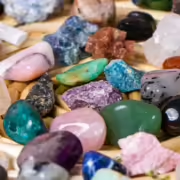
Amazonite, a gem with a soothing, enchanting hue, captures the imagination of mineral enthusiasts and intrigues spiritual seekers.
In this fascinating exploration of Amazonite, we delve into its geological origins, reveal the magnificence of crystals in their raw state, and explore the dazzling spread of this stone around the world. Along the way, we’ll unravel the threads of its enigmatic history, offering an in-depth look at this unique and mysterious gem.
Raw Amazonite – James St. John, CC BY 2.0
The geological formation of Amazonite is a fascinating process that results from specific geological conditions over vast periods of time. Amazonite is a variety of microcline, a type of potassium feldspar, which forms mainly in pegmatites, mineral-rich magmatic rocks. These pegmatites are generally formed during the slow crystallization of magma, allowing the minerals to develop into large crystals.
Over time, hydrothermal fluids rich in elements such as potassium and lead migrate through fractures and cracks in the surrounding rocks. These fluids can react with feldspar, causing chemical changes that lead to the formation of Amazonite. The presence of lead and water in these fluids plays a crucial role in the development of Amazonite’s characteristic color, which varies from pale green to turquoise green.
Rough Amazonite – Natural Radiance Revealed
Like many polycrystalline minerals, Amazonite is most often found as massive crystals, which can be polished to reveal their characteristic luster.
Sources – Amazonite Worldwide Presence
Amazonite deposits are often found in granitic regions where pegmatites are abundant. Areas of the world known for their Amazonite deposits include Brazil, Peru, Russia, the USA (mainly Colorado) and Ethiopia, although smaller occurrences can be found in other parts of the world.
Historical Significance of Amazonite – A Mystical Heritage
Amazonite has a rich and fascinating history going back thousands of years, making it a gemstone deeply rooted in the cultures and beliefs of many civilizations. Its soothing beauty and varied shades have attracted human attention since ancient times, leading to its widespread use in jewelry, ornaments and ritual objects.
Ancient civilizations of Mesopotamia and Egypt: The civilizations of ancient Mesopotamia and Egypt attached great importance to Amazonite. Artefacts containing Amazonite have been discovered in Egypt’s royal tombs, notably those of the pharaohs Ramses II, on view at the Louvre, and Tutankhamun. The Egyptians used Amazonite to make amulets, scarabs and other protective objects, believing in its powers to ward off evil forces and bring good fortune.
Mayan peoples: The Mayans, a remarkable pre-Columbian civilization that flourished in Central America, were also familiar with Amazonite. Although this stone was not as abundant in their region as in other parts of South America, artifacts containing Amazonite have been discovered in Mayan archaeological sites.
Amazons and the El Dorado legend: Amazonite takes its name from the legend that it was discovered in the region that was once the territory of the Amazons, the mythical warriors of ancient Greece. Spanish conquistadors, drawn by tales of golden cities such as El Dorado, actively sought out Amazonite in their quest for wealth and power.
Conquistadors’ discoveries in South America: When the Spanish conquistadors explored South America in the 16th century, they discovered rich deposits of Amazonite in the Andes, notably in Peru and Brazil. They brought these precious stones back to Europe, where they were used to make jewelry for the nobility and high society.
Native peoples of North and South America: Native peoples of North and South America used Amazonite in their rituals and sacred ceremonies. They believed in its healing and protective properties, as well as its ability to foster spiritual communication. Amazonite was often carved into amulets and talismans, worn as symbols of strength and connection with nature.
Esoteric traditions and lithotherapy: In modern times, Amazonite continues to be revered for its esoteric properties and therapeutic benefits. Lithotherapy practitioners recommend it to relieve stress, promote communication and strengthen the heart chakra. It is also associated with luck and prosperity, attracting those seeking harmony and abundance in their lives.
Metaphysical properties of Amazonite – Serenity energy
Amazonite is renowned for its metaphysical properties that promote serenity, harmony and clear communication. Its soothing color is associated with emotional healing and energy purification.
Amazonite varieties
Amazonite has no varieties to speak of.
Amazonite colors
Amazonite’s hues range from pale green to turquoise-greenish-blue, sometimes with white or gray inclusions. Its distinct, soothing color makes it a prized gem in the world of jewelry and lithotherapy.
Durability and portability of Amazonite
With a hardness of 6 to 6.5 on the Mohs scale, Amazonite is durable enough to be used in jewelry. However, due to its relative fragility, it should be handled with care to avoid chipping or scratching.
Amazonite Enhancements – Preserving its Natural Splendor
Enhancements to Amazonite aim to preserve its natural splendor while improving its aesthetic characteristics or durability. Here are some commonly used techniques:
Impregnations: Impregnation involves impregnating Amazonite with a transparent resin or polymer to improve its clarity, color or durability. This technique is often used to stabilize fragile stones containing numerous fractures, or to enhance their resistance to impact and scratching while preserving their natural appearance.
Tinting: Tinting is sometimes applied to modify or intensify the color of Amazonite. Natural or synthetic colorants are used to create more vibrant hues or to even out the color of the stone. Although staining can produce visually appealing effects, it is important that buyers are informed of any modifications to the stone.
Synthetic Amazonite – Nature in the Lab
Although synthetic Amazonite has been created, it is very rare on the market. You’re more likely to find imitation or real amazonite than synthetic amazonite.
Amazonite Imitations – Distinguishing the Authentic
Amazonite can be imitated using synthetic materials or natural stones dyed to reproduce its color and appearance. The most common culprits are blue-green-tinted howlite and dyed quartz (including agate).
Amazonite care – Preserving its beauty
To preserve the beauty and brilliance of Amazonite, we recommend regular cleaning with a soft, damp cloth.
Avoid prolonged exposure to direct sunlight and harsh chemicals to prevent discoloration or damage.
By following these care tips, you can enjoy the natural splendor of your Amazonite for many years to come.
https://www.icia.uk/wp-content/uploads/2026/11/logo-1.svg00ICIA Media Centerhttps://www.icia.uk/wp-content/uploads/2026/11/logo-1.svgICIA Media Center2022-02-22 00:00:002022-02-22 00:00:00Amazonite: Properties, Uses and Virtues
We may request cookies to be set on your device. We use cookies to let us know when you visit our websites, how you interact with us, to enrich your user experience, and to customize your relationship with our website.
Click on the different category headings to find out more. You can also change some of your preferences. Note that blocking some types of cookies may impact your experience on our websites and the services we are able to offer.
Essential Website Cookies
These cookies are strictly necessary to provide you with services available through our website and to use some of its features.
Because these cookies are strictly necessary to deliver the website, refusing them will have impact how our site functions. You always can block or delete cookies by changing your browser settings and force blocking all cookies on this website. But this will always prompt you to accept/refuse cookies when revisiting our site.
We fully respect if you want to refuse cookies but to avoid asking you again and again kindly allow us to store a cookie for that. You are free to opt out any time or opt in for other cookies to get a better experience. If you refuse cookies we will remove all set cookies in our domain.
We provide you with a list of stored cookies on your computer in our domain so you can check what we stored. Due to security reasons we are not able to show or modify cookies from other domains. You can check these in your browser security settings.
Other external services
We also use different external services like Google Webfonts, Google Maps, and external Video providers. Since these providers may collect personal data like your IP address we allow you to block them here. Please be aware that this might heavily reduce the functionality and appearance of our site. Changes will take effect once you reload the page.
Google Webfont Settings:
Google Map Settings:
Google reCaptcha Settings:
Vimeo and Youtube video embeds:
Privacy Policy
You can read about our cookies and privacy settings in detail on our Privacy Policy Page.