International Crystal Industry Alliance
  • Home
  • About Us
    • Who We Are
    • Global Governance
    • Headquarters & Global Labs
    • Team & Leadership
  • Standards
    • CCGS
    • RCGS
    • MSGS
    • Treatment Disclosure Guide
    • Gemstone Encyclopedia
  • Verification & Traceability
    • IGSTS 3D Biometric System
    • Certificate Search
    • Global Directory & Public Registry
  • Education & Research
    • ICIA Crystal and Gemstone Academy
    • IMGRI
  • Membership & Compliance
    • Certification Committee
    • Professional Credentials
    • OAISS
    • Expedited Re-Testing
    • ADRPS
  • Media Center
    • Press Releases
    • Whitepapers & Downloads
    • Industry Blog & Trends
  • Click to open the search input field Click to open the search input field Search
  • Menu Menu

Sphene (titanite): Properties, Uses and Virtues

February 22, 2022/0 Comments/in Gem Encyclopedia, Using Crystal/by ICIA Media Center

Sphene, also known as titanite, is a common component of various rocks and a rare gem for collectors. With a more intense fire than diamond but a hardness of 5.5 on the Mohs scale, and distinct cleavage, it is easy to damage. Coloured yellow, brown, green, colourless, orange, pinkish-red or black, this gem is rarest in its chrome version, which shows an emerald green, and polychroism is not uncommon. Often associated with mental clarity, sphene is often included and it is very rare to find perfectly clear stones cut to the right size.
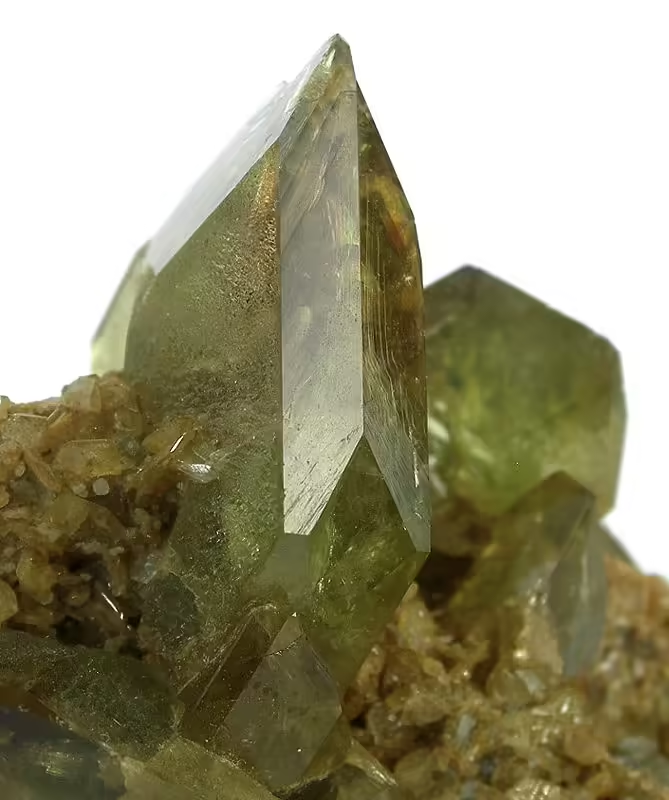
Sphene or Titanite – Rob Lavinsky, CC-BY-SA-3.0

Sphene Geological Formation

Sphene, also known as titanite, is a gemstone that forms in a variety of geological environments, often associated with metamorphic rocks such as gneiss and marble. Its formation is the result of complex geological processes involving the presence of titanium and silicate under specific temperature and pressure conditions.

Rough Sphene – The crystalline beauty of the earth

Sphene is distinguished by its characteristic prismatic crystals, which are often flat and angular. They can also be found in massive form (clusters of micro-crystals). These crystals are often highly dispersive, which means that they scatter light spectacularly, creating flashes of bright, sparkling colour, a phenomenon known as ‘fire’.

Sources – The global presence of sphene

Sphene is widespread throughout the world, with significant deposits in Europe, Asia, North America and Africa. Examples of major deposits can be found in Madagascar, Canada, Mexico, Brazil and India.

History of Sphene – Through the ages

The first name for titanite dates back to the 18th century and is attributed to Martin Klaproth.

Unfortunately, there are not many studies on the use of sphene or titanite in jewellery over the centuries.

Today, sphene is still used in jewellery to create unique and dazzling pieces. It is appreciated for its rarity and its fire, which is more intense than that of a diamond.

Metaphysical properties of Sphene

On a metaphysical level, sphene is often associated with mental clarity, inner strength and spiritual growth. It is said to stimulate the intellect, promote concentration and help overcome mental obstacles.

Varieties of Sphene

There are no distinct gemmological varieties of sphene. It is, however, part of an extended geological family.

Sphene colors

Sphene can display a range of colours, from yellow, brown, green, orange, pinkish red, grey, colourless and even black, with variations in hue and saturation. The emerald green colour of chrome sphene is the most sought-after and the rarest.

Sphene has a strong internal fire and ‘glows’ more intensely than diamond. It also has a strong pleochroism that causes the stone to change colour depending on the angle at which it is viewed.

Durability and portability of sphene

Sphene is relatively soft, with a hardness of 5.5 on the Mohs scale, making it suitable for use in jewellery if the stone is well protected. However, it is very fragile and prone to breakage, so care must be taken.

Sphene enhancements

Sphene can be heat treated to improve its colour. It is possible to make sphene red or orange using this process.

Synthetic Sphene

Sphene, or titanite, was synthesized for research purposes. However, it is not available on the market.

Sphene Imitations

CZ and red garnets were used to imitate sphene, as was zircon. The garnets imitate the colour, while the CZ and zircon imitate the fires that are very present inside the stone.

Conversely, sphene can be used to imitate the highly sought-after demantoid garnet.

Caring for sphene

To preserve the beauty of the sphene, we recommend cleaning it regularly with a soft cloth and lukewarm water. Avoid harsh chemicals and store it separately from other jewellery to avoid scratches.
Tags: Sphene, titanite
Share this entry
  • Facebook Facebook Share on Facebook
  • X-twitter X-twitter Share on X
  • Whatsapp Whatsapp Share on WhatsApp
  • Pinterest Pinterest Share on Pinterest
  • Linkedin Linkedin Share on LinkedIn
https://www.icia.uk/wp-content/uploads/2024/11/Titanite-rom08f-jpg.avif 800 669 ICIA Media Center https://www.icia.uk/wp-content/uploads/2026/11/icia-logo-600-250.avif ICIA Media Center2022-02-22 00:00:002024-11-30 01:13:01Sphene (titanite): Properties, Uses and Virtues
You might also like
Titanite (Sphene)
Search Search
  • Global Gemstone & Fine Jewelry Market: Key News & Strategic Trend Outlook
  • ICIA Officially Prohibits Subjective “3A/5A/7A” Marketing Labels, Mandating 100-Point CCGS Empirical Standards Worldwide
  • The Timeless Appeal of Natural Jewellery
  • China’s Gem and Jewellery Industry: A Practical Overview
  • Geopolitical Impact Assessment on Mineral Assets
  • Latest Developments in Hong Kong’s Jewellery and Diamond Industry
  • 2026 Crystal Trends: What’s Rising, What’s Shifting, What’s Worth Your Money
  • Report on the Current Status and Market Outlook of the Crystal Industry (2026–2032)
  • Crystal Market Size | 2026–2035
  • Crystal & Gemstone Market Development Report — 2026
  • 2026 Jewelry Trends: The Big Shift Away from “Quiet”
  • Super hard “super diamond” developed in China, 40% stronger than natural diamond

Subscribe to our Blog

ICIA - International Crystal Industry Alliance

An independent, non-governmental international metrological and regulatory alliance establishing empirical crystal grading codices (CCGS, RCGS, MSGS) and sovereign ledger verification under English Common Law.

ICIA General Secretariat Hubs
London (United Kingdom) • Geneva (Switzerland) • Hong Kong
Governance & Organs
  • ICIA General Meeting
  • Board of Governors
  • ICIA General Secretariat
  • Institute of Gemstone & Mineral Research (IGMRI)
  • ICIA Crystal and Gemstone Academy (ICGA)
  • Ethics and Sustainability Committee (ESC)
  • OAISS Supervision Service
Charter & Compliance
  • ICIA Charter & Bylaws
  • ICIA Arbitration & Appraisal Committee (IAAC)
  • ADRPS Regulations
  • GDPR & Data Protection
  • Global Privacy Policy
  • Copyright & Legal Notice
  • Contact General Secretariat
Trust & Metrology
• OAISS SUPERVISED
• MICRO-FTIR 3054 cm-1
• IGSTS • cert.icia.uk
• CCGS (4C+1I) • RCGS (5R) • MSGS (4M)
Verify Ledger →
ICIA Sovereign Seal

ICIA SOVEREIGN SEAL
EST. 2015 • LONDON & GENEVA

OAISS SUPERVISED
SUPERVISION SERVICE

IGMRI METROLOGY
MICRO-FTIR 3054 cm-1

CODEX STANDARDS
CCGS (4C+1I) • RCGS (5R) • MSGS (4M)

IGSTS LEDGER
SHA-256 • CERT.ICIA.UK

Statutory Legal Disclaimer: ICIA (International Crystal Industry Alliance) is an independent, non-governmental regulatory alliance. Certifications issued under the authority of the ICIA Certification Council pursuant to CCGS (4C+1I), RCGS (5R), and MSGS (4M) empirical frameworks verify physical specimen properties at the time of laboratory inspection and do not constitute a direct commercial guarantee of secondary market liquidity.
© 2015–2026 International Crystal Industry Alliance (ICIA™). All Rights Reserved.
Administered by ICIA General Secretariat • Statutory Seat: London, UK
Link to: Spinel: Properties, Uses and Virtues Link to: Spinel: Properties, Uses and Virtues Spinel: Properties, Uses and Virtues Link to: Spessartite garnet: Properties, Uses and Virtues Link to: Spessartite garnet: Properties, Uses and Virtues Spessartite garnet: Properties, Uses and Virtues
Scroll to top Scroll to top Scroll to top