
Smelting crystal
Definition and Production Process
Smelting crystal refers to crystal materials that are produced through a smelting process. It starts with raw materials like natural quartz ores or quartz sand which contain certain impurities. These raw materials are first crushed and then placed into high-temperature smelting furnaces. The temperature in the furnace is typically raised to around 1700 – 1800 degrees Celsius. Under such intense heat, the quartz undergoes melting. During this process, some of the impurities will either rise to the surface or be separated out in other ways. After that, through controlled cooling and solidification, the smelting crystal is formed.
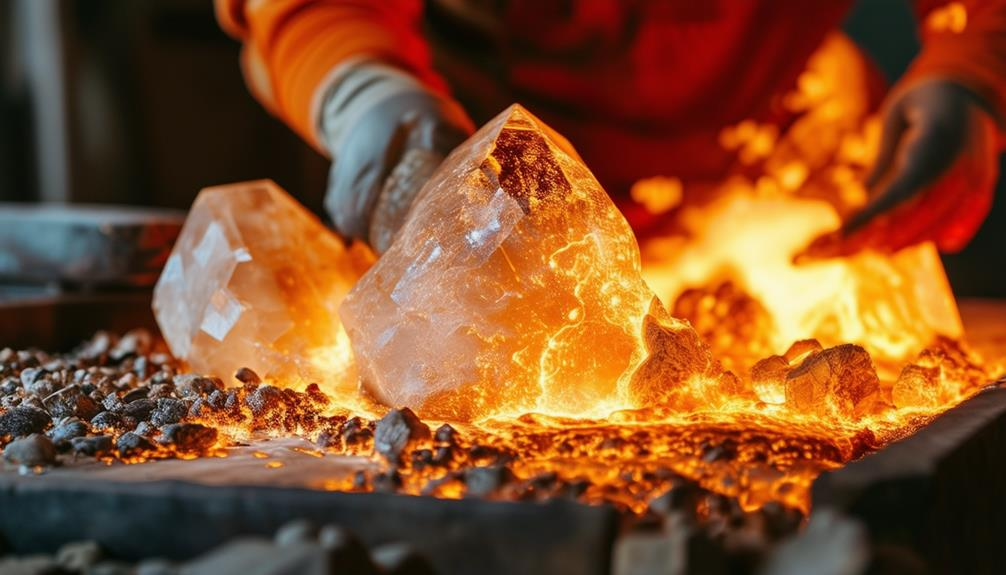
Types of Smelting Crystals
- Based on Chemical Composition:
- Silica-based Smelting Crystals: The most common ones are mainly composed of silica (SiO₂). These are widely used in various industries due to the abundance of silica-containing raw materials and their relatively stable properties after smelting.
- Compound Smelting Crystals: Some smelting crystals may contain additional elements or compounds intentionally added during the smelting process to achieve specific properties. For example, adding certain metal oxides can alter the color or electrical properties of the crystal.
- Based on Intended Use:
- Jewelry-grade Smelting Crystals: These are processed to have relatively better appearance characteristics, such as a certain level of transparency and smoothness. They are used in making inexpensive jewelry items or decorative accessories, although they may not have the same quality as natural high-end crystals.
- Industrial-grade Smelting Crystals: Manufactured to meet the requirements of industrial applications. For example, they can be used in the production of electronic components due to their piezoelectric properties or as raw materials for making optical elements like lenses in some less demanding optical devices.
Characteristics
- Physical Characteristics:
- Hardness: Generally, smelting crystals have a hardness similar to that of natural crystals of the same type. For example, silica-based smelting crystals usually have a Mohs hardness around 7, which means they have a certain level of resistance to scratching and wear, making them suitable for various applications where durability is needed.
- Transparency: While they can be transparent to some degree, compared to high-quality natural crystals, smelting crystals often have lower transparency. There may be visible inclusions, tiny bubbles, or an uneven internal structure that affect the clarity of light passing through them. This is mainly due to the imperfect removal of impurities during the smelting process.
- Refractive Index: Their refractive index values are usually in a similar range to natural crystals but may vary slightly depending on the specific composition and processing conditions. For example, silica-based smelting crystals typically have a refractive index in the range of 1.544 – 1.553.
- Chemical Characteristics:
- Chemical Stability: They are relatively stable under normal environmental conditions. For silica-based smelting crystals, they are resistant to most common acids and alkalis to some extent, but strong chemical reagents can still react with them under certain circumstances.
- Impurity Content: Usually contain a certain amount of impurities despite efforts to remove them during smelting. These impurities can affect their physical and chemical properties as well as their appearance, as mentioned earlier.
Applications
- Jewelry and Decorative Items: In the jewelry industry, smelting crystals are used to make affordable jewelry pieces like necklaces, bracelets, and earrings. They can also be used to adorn handicrafts, adding a shiny and crystal-like look. For example, colored smelting crystals can create vivid and eye-catching decorative effects.
- Industrial Applications:
- Electronics: Utilized in the manufacturing of electronic components such as quartz oscillators and filters. The piezoelectric effect of certain smelting crystals enables them to convert mechanical energy into electrical energy and vice versa, which is crucial for the proper functioning of many electronic devices in the fields of communication, computing, and more.
- Optics: Can be used as raw materials for making some optical elements in less precise optical instruments. Although their optical properties may not be as excellent as those of high-quality natural crystals, they can still meet the requirements of some general optical applications due to their relatively low cost.
- Glass and Ceramic Manufacturing: Added to glass or ceramic materials as additives to improve properties like hardness, transparency, or glaze quality. For example, in glass production, smelting crystals can enhance the refractive index and make the glass more durable.
Comparison with Natural Crystals
- Quality and Appearance: Natural crystals often have a more uniform internal structure, higher transparency, and a purer appearance. They may also have unique inclusions or growth patterns that give them special aesthetic and collectible value. In contrast, smelting crystals usually have more visible flaws and a less natural look.
- Value: Natural crystals, especially those that are rare and of high quality, can have significant collectible and investment value. Smelting crystals, on the other hand, are mainly mass-produced for practical applications and generally have a much lower value in the market.
- Origin and Formation: Natural crystals form over long periods of time under specific geological conditions in nature. Smelting crystals are the result of human-controlled manufacturing processes in factories.
In conclusion, smelting crystals play an important role in both the decorative and industrial fields, although they differ from natural crystals in multiple aspects.

