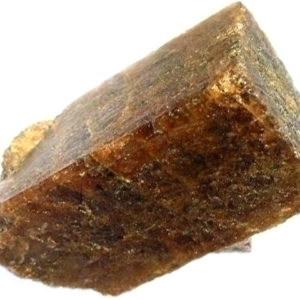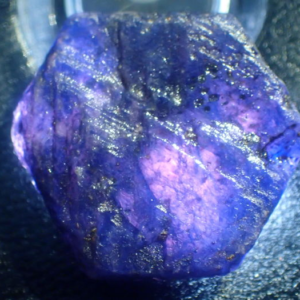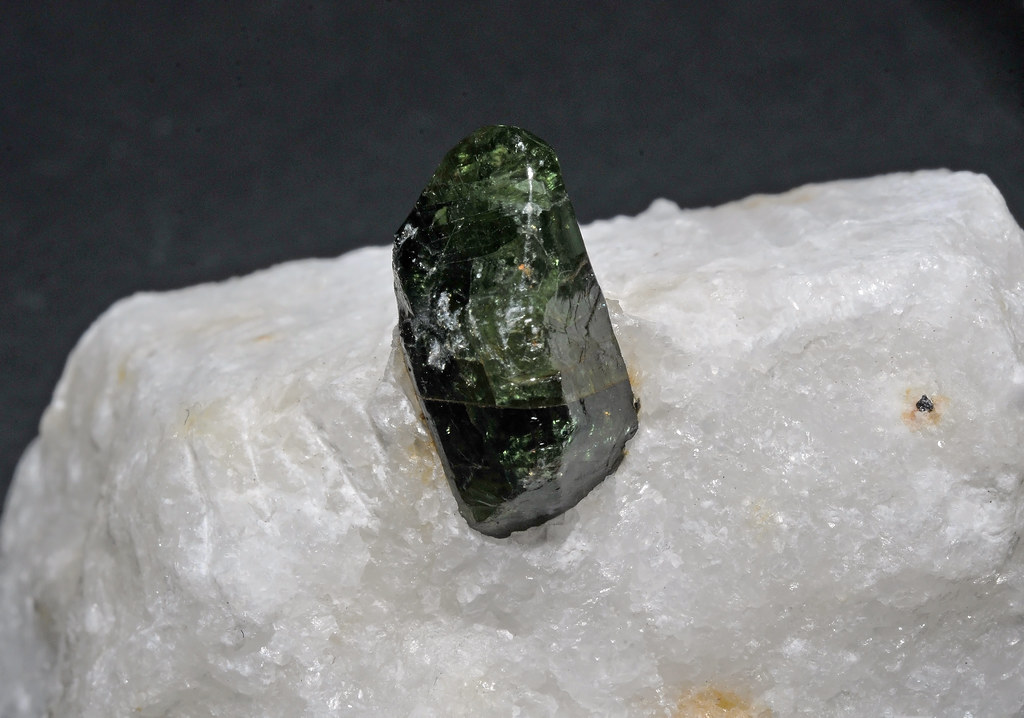
Diopside

 Aliabad, Hunza Valley, Gilgit District, Gilgit-Baltistan (Northern Areas), Pakistan

Diopside is a member of pyroxene group mineral with formula is MgCaSi2O6. Specimens can be colorless but are more often bottle green, brownish green, or light green in color. It has two distinct prismatic cleavages at 87 and 93° typical of the pyroxene series. Diopside occurs in the form of equant to prismatic crystals that are usually nearly square in section. Crystals are less commonly tabular. This mineral can also form columnar, sheetlike, granular, or massive aggregates. Most diopside is metamorphic and found in metamorphosed silica-rich limestones and dolomites and in iron-rich contact metamorphic rocks. It also occurs in peridotites, kimberlites, and other igneous rocks. It forms complete solid solution series with hedenbergite (FeCaSi2O6) and augite, and partial solid solutions with orthopyroxene and pigeonite. .
Name: From two Greek words meaning double and appearance, since the prism zone can apparently be oriented in two ways.
Association: Calcite, forsterite, chondrodite, monticellite, clinohumite, scapolite, wollastonite, grossular, vesuvianite, tremolite, quartz
Composition: Calcium-magnesium silicate, CaMgSi20 6. CaO = 25.9 per cent, MgO = 18.5 per cent, Si02 = 55.6 per cent. Iron may replace magnesium in all proportions, and an isomorphous series exists between diopside and hedenbergite, CaFcSi20 6
Diagnostic Features: Characterized by its crystal form, light color, and imperfect prismatic cleavage at 87° and 93°.
Polymorphism & Series: Forms two series, with hedenbergite, and with johannsenite
Mineral Group: Pyroxene group.
Cell Data: Space Group: C2=c: a = 9.746 b = 8.899 c = 5.251 ¯ = 105:63 ± Z = 4
Crystallography: Monoclinic; prismatic. In prismatic crystals showing square or eight-sided cross section. Also granular massive, columnar, and lamellar. Frequently twinned polysynthetically with the basal pinacoid {001) the twin plane. Less commonly twinned on the orthopinacoid {100}.
Contents
- Chemical Properties
- Diopside Physical Properties
- Diopside Optical Properties
- Occurrence
- Uses Area
- Distribution
- References
Chemical Properties
| Chemical Classification | Inosilicate mineral |
| Formula | CaMgSi2O6 |
| Common Impurities | Fe,V,Cr,Mn,Zn,Al,Ti,Na,K |
Diopside Physical Properties
| Color | light to dark green, blue, brown, colourless, snow white, grey, pale violet |
| Streak | white |
| Luster | Vitreous, Dull |
| Cleavage | Distinct/Good on {110} |
| Diaphaneity | Transparent, Opaque |
| Mohs Hardness | 5,5 – 6,5 |
| Crystal System | Monoclinic |
| Tenacity | Brittle |
| Density | 3.22 – 3.38 g/cm3 (Measured) 3.278 g/cm3 (Calculated) |
| Fracture | Irregular/Uneven, Conchoidal |
| Parting | on {100} and probably {010} |
| Crystal habit | Short prismatic crystals common, may be granular, columnar, massive |
| Melting point | 1391 °C |
Diopside Optical Properties
| Color / Pleochroism | White to light green No pleochroism Colorless to pale green in thin section |
| 2V: | Measured: 58° to 63°, Calculated: 56° to 64° |
| RI values: | nα = 1.663 – 1.699 nβ = 1.671 – 1.705 nγ = 1.693 – 1.728 |
| Twinning | Simple and multiple twins common on {100} and {001} |
| Optic Sign | Biaxial (+) |
| Birefringence | δ = 0.030 |
| Relief | High |
| Dispersion: | weak to distinct r > v |
| Elongation | parallel to c axis |
| Extinction | inclined in (010) sections |
Occurrence
Diopside is characteristically found as a contact metamorphic mineral in crystalline limestones. In such deposits it is associated with tremolite, scapolite, idocrase, garnet, sphene. It is also found in regionally metamorphosed rocks. The variety diallage is frequently found in gabbros, peridotites, and serpentines.
Uses Area
- Diopside-based ceramics and glass ceramics have potential applications in various technological fields.
- Transparent diopside varieties cut and gem stones
- Similarly, diopside-based ceramics and glass ceramics have potential applications in the field of biomaterials in solid oxide fuel cells, nuclear waste immobilization and sealing materials.
Distribution
Selected localities for ne crystals follow:
- at Schwarzenstein, Zillertal, and near PrÄagraten, Tirol, Austria.
- From Ala, Piedmont, and St. Marcel, Val d’Aosta, Italy.
- At Otokumpu, Finland.
- In Russia, at the Akhmatovsk deposit, near Zlatoust, Ural Mountains; large crystals in the Inagli massif, 30 km west of Aldan, Yakutia; and along the Slyudyanka River, near Lake Baikal, Siberia.
- In Canada, many localities; in Ontario, at Bird’s Creek, Eganville, Dog’s Lake, Littleeld, and Burgess; in Quebec, at Wakeeld, Brompton Lake, near Magog, and in the Je®rey mine, Asbestos.
- In the USA, at DeKalb, St. Lawrence Co., Natural Bridge, Je®erson Co., Sing Sing, near Ossining, Westchester Co., New York; and at Ducktown, Polk Co., Tennessee.
- At Ampandrandava and Andranodambo, TaolanÄaro (Fort Dauphin), Madagascar.
- Large gemmy crystals from the Kunlun Mountains, Sinkiang Uighur Autonomous Region, China.
- From Tange-Achin, Kandahar Province, Afghanistan.
- Found near Jaipur, Rajasthan, India.
- At Khapalu and Chamachu, Pakistan.
References
- Bonewitz, R. (2012). Rocks and minerals. 2nd ed. London: DK Publishing.
- Dana, J. D. (1864). Manual of Mineralogy… Wiley.
- Handbookofmineralogy.org. (2019). Handbook of Mineralogy. [online] Available at: http://www.handbookofmineralogy.org [Accessed 4 Mar. 2019].
- Mindat.org. (2019): Mineral information, data and localities.. [online] Available at: https://www.mindat.org/ [Accessed. 2019].
- Smith.edu. (2019). Geosciences | Smith College. [online] Available at: https://www.smith.edu/academics/geosciences [Accessed 15 Mar. 2019].