Axinite
Axinite is a group of uncommon, typically brown or violet-brown borosilicate minerals that form in specific geological settings. Known for its sharp, wedge-shaped crystals and unique properties, axinite has captivated geologists and mineral collectors alike.
 Contents
 Chemically, axinites are complex borosilicate minerals, typically represented by the general formula ( \text{(Ca, Fe, Mn, Mg)}3\text{Al}_2\text{BO}_3(\text{Si}_4\text{O}{12})(\text{OH)} ). They belong to the triclinic crystal system, forming wedge-shaped or tabular crystals that often exhibit a distinctive “ax-head” shape, which inspired their name (from the Greek word “axine,” meaning “axe”).
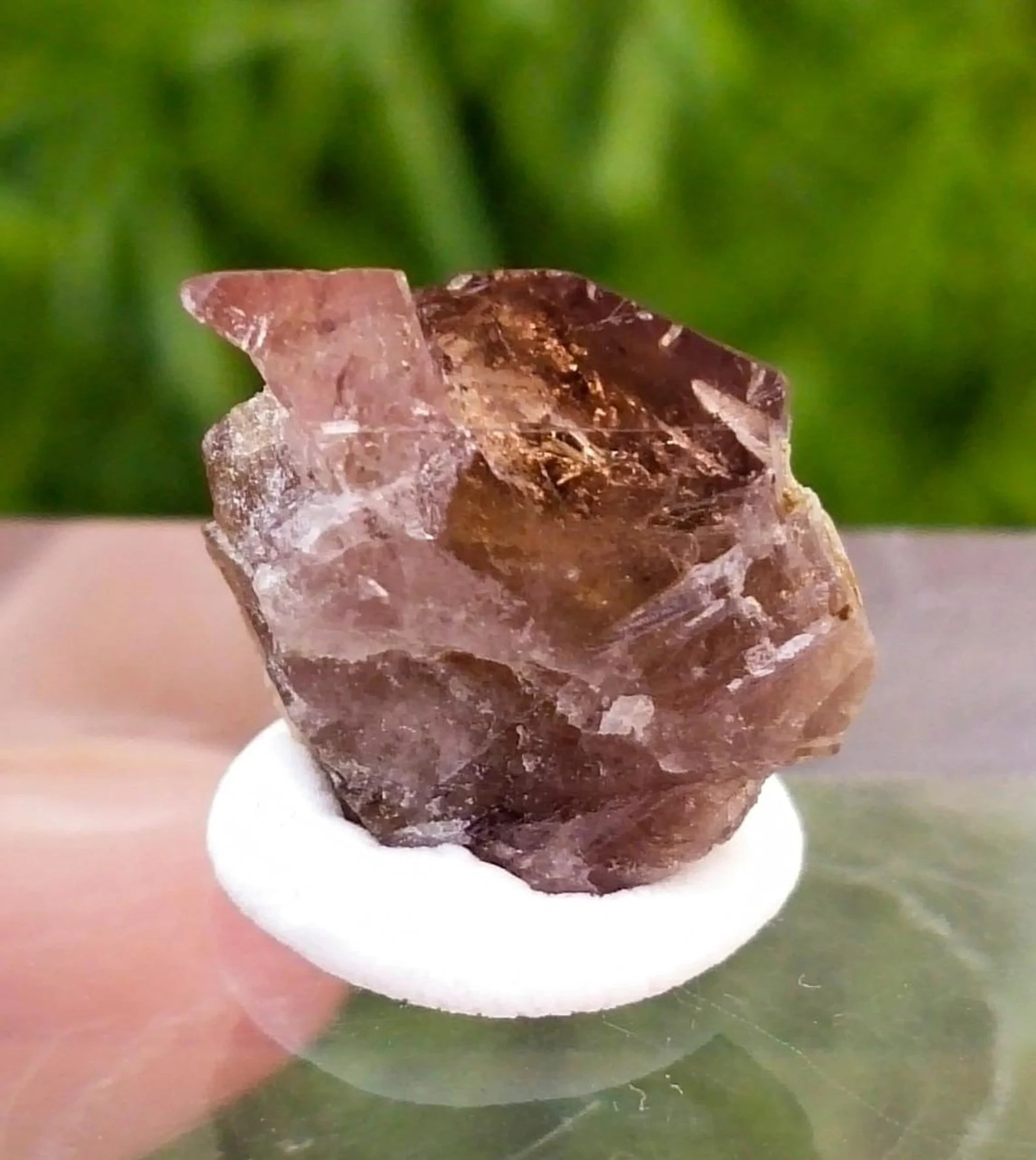
Axinite’s color varies from light brown to deep purple-brown, often influenced by the iron content, with richer iron contents producing darker hues. These minerals have a hardness of 6.5 to 7 on the Mohs scale, making them relatively hard but still workable for collectors. Axinites display vitreous to resinous luster, contributing to their appeal as gemstones, though they are rare in jewelry due to their scarcity.
 Axinite has a complex and highly symmetrical crystal structure. It consists of interconnected silicate tetrahedra (SiO₄), arranged with boron-centered polyhedra and metal cations like Ca²⁺, Fe²⁺, or Mn²⁺, which provide charge balance. This structure gives axinite a high degree of symmetry and stability, contributing to its distinct crystal habit.
These crystals often exhibit good cleavage, and in certain orientations, they may even appear translucent. Axinite crystals are also known for their strong pleochroism — the color change when viewed from different angles — which ranges from shades of brown and violet to colorless. This optical property is one of the distinguishing features of axinite.
 Axinite forms under specific conditions where boron, a relatively rare element in the Earth’s crust, is concentrated. Boron often originates from deep-seated magmatic processes or from the breakdown of boron-bearing minerals like tourmaline. This element is then mobilized by hydrothermal fluids, which deposit axinite as they infiltrate rocks under moderate pressures and temperatures.
Common geological settings where axinite may form include:
 Axinite is rare, and its occurrences are limited to a few notable localities worldwide, where the necessary conditions for its formation are met. Some famous axinite localities include:
 While axinite is not widely used industrially, it is of interest in scientific studies and as a collector’s mineral. Geologists study axinite to understand the role of boron in metamorphic processes and to gain insights into fluid-rock interactions during the formation of skarns and other mineral deposits. The unique chemical composition of axinite makes it useful in research on borosilicate minerals, which have applications in materials science due to their thermal stability and low thermal expansion.
In the gem trade, axinite is occasionally cut into gemstones, though its brittleness and scarcity make it a rare choice for jewelry. When used, axinite gemstones are valued for their unique pleochroism and range of colors, often showcased in custom settings.
Contents
- Mineralogy and Properties of Axinite
- Crystal Structure and Physical Characteristics
- Formation and Geology of Axinite
- Geological Occurrences and Localities
- Applications and Uses
- Conclusion
Mineralogy and Properties of Axinite
The axinite mineral group includes several species, all sharing a similar crystal structure but with variations in composition. The primary members are axinite-(Fe), axinite-(Mg), axinite-(Mn), and axinite-(Ca). Each type is named for the dominant metal in its chemical structure:- Axinite-(Fe): Contains iron (Fe) as the dominant metal.
- Axinite-(Mg): Contains magnesium (Mg).
- Axinite-(Mn): Contains manganese (Mn).
- Axinite-(Ca): Calcium (Ca) predominates in the structure.
Chemically, axinites are complex borosilicate minerals, typically represented by the general formula ( \text{(Ca, Fe, Mn, Mg)}3\text{Al}_2\text{BO}_3(\text{Si}_4\text{O}{12})(\text{OH)} ). They belong to the triclinic crystal system, forming wedge-shaped or tabular crystals that often exhibit a distinctive “ax-head” shape, which inspired their name (from the Greek word “axine,” meaning “axe”).
Axinite’s color varies from light brown to deep purple-brown, often influenced by the iron content, with richer iron contents producing darker hues. These minerals have a hardness of 6.5 to 7 on the Mohs scale, making them relatively hard but still workable for collectors. Axinites display vitreous to resinous luster, contributing to their appeal as gemstones, though they are rare in jewelry due to their scarcity.
Crystal Structure and Physical Characteristics
Axinite has a complex and highly symmetrical crystal structure. It consists of interconnected silicate tetrahedra (SiO₄), arranged with boron-centered polyhedra and metal cations like Ca²⁺, Fe²⁺, or Mn²⁺, which provide charge balance. This structure gives axinite a high degree of symmetry and stability, contributing to its distinct crystal habit.
These crystals often exhibit good cleavage, and in certain orientations, they may even appear translucent. Axinite crystals are also known for their strong pleochroism — the color change when viewed from different angles — which ranges from shades of brown and violet to colorless. This optical property is one of the distinguishing features of axinite.
Formation and Geology of Axinite
Axinite is a metamorphic mineral, typically forming in low- to medium-grade metamorphic environments. It is commonly associated with contact metamorphism and hydrothermal alterations, where hot, mineral-rich fluids interact with host rocks, causing chemical exchanges and mineral transformations.
Axinite forms under specific conditions where boron, a relatively rare element in the Earth’s crust, is concentrated. Boron often originates from deep-seated magmatic processes or from the breakdown of boron-bearing minerals like tourmaline. This element is then mobilized by hydrothermal fluids, which deposit axinite as they infiltrate rocks under moderate pressures and temperatures.
Common geological settings where axinite may form include:
- Contact Zones: Axinite is often found in the contact zones between igneous intrusions and surrounding rocks, particularly in areas where boron-rich fluids infiltrate from the magma into surrounding rock.
- Skarn Deposits: Axinite frequently appears in skarn deposits, which form when carbonate-rich sedimentary rocks (such as limestone) undergo metamorphism due to an intrusion of magma. The resultant chemical reactions produce a variety of silicate minerals, including axinite.
- Alpine-Type Metamorphic Zones: In high mountain belts, where rocks experience intense tectonic pressures, axinite is often a byproduct of metamorphic activity. The mineral can also be found in pegmatite veins, associated with boron-bearing minerals in regional metamorphic terrains.
Geological Occurrences and Localities
Axinite is rare, and its occurrences are limited to a few notable localities worldwide, where the necessary conditions for its formation are met. Some famous axinite localities include:
- France: The Alps of France, particularly in regions such as Bourg d’Oisans, have long been known as a source of high-quality axinite crystals. These specimens are often violet-brown, translucent, and exhibit well-defined crystal structures, making them highly prized among collectors.
- Pakistan: In the Gilgit-Baltistan region, axinite occurs in association with other rare minerals in high-pressure, low-temperature metamorphic rocks. This area has yielded some of the most transparent and gem-quality axinite specimens.
- Russia: The Dalnegorsk region of Russia is also renowned for axinite, particularly axinite-(Fe), which forms in skarn environments near limestone intrusions. Dalnegorsk specimens are typically darker in color and may exhibit larger crystal sizes.
- United States: Axinite has been found in several locations, including California (specifically in San Diego County), where it occurs in metamorphic rock formations. California axinites tend to be iron-rich and are often brown or reddish-brown.
- Japan: In Japan, the town of Obira in Hokkaido is known for producing axinite crystals associated with regional metamorphism.
Applications and Uses
While axinite is not widely used industrially, it is of interest in scientific studies and as a collector’s mineral. Geologists study axinite to understand the role of boron in metamorphic processes and to gain insights into fluid-rock interactions during the formation of skarns and other mineral deposits. The unique chemical composition of axinite makes it useful in research on borosilicate minerals, which have applications in materials science due to their thermal stability and low thermal expansion.
In the gem trade, axinite is occasionally cut into gemstones, though its brittleness and scarcity make it a rare choice for jewelry. When used, axinite gemstones are valued for their unique pleochroism and range of colors, often showcased in custom settings.