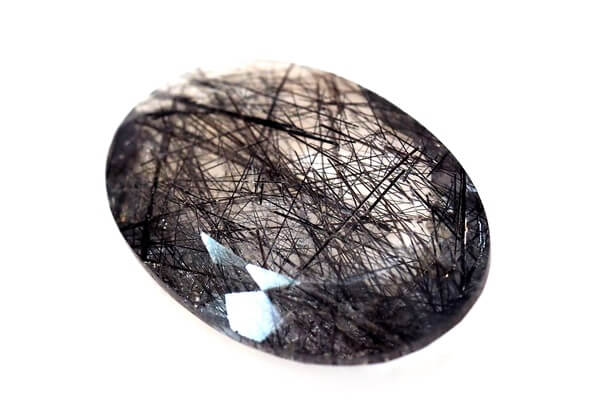
The Art and Science of Rutilated Quartz: Why Collectors Demand RCGS (5R) Certification
Among all members of the quartz family, few varieties captivate collectors and bespoke jewelry houses like Rutilated Quartz. Formed over millions of years when needle-like crystals of titanium dioxide ($\text{TiO}_2$)—known mineralogically as rutile—crystallized inside transparent quartz hosts, fine rutilated quartz displays striking metallic gold, copper, silver, or red-brown formations suspended in crystal-clear space.
Yet as global demand and auction prices for top-tier golden and red rutilated quartz have climbed, the market has faced a persistent problem: how do you objectively grade a gemstone whose beauty depends on internal inclusions?
Why Diamond-Centric Grading Models Fail Rutilated Quartz Conventional gemological grading systems were designed primarily around faceted diamonds and transparent colored gemstones, where internal inclusions are treated almost exclusively as flaws that lower clarity grades. Apply that rubric to rutilated quartz and the logic collapses—because in rutilated quartz, the inclusions are the artwork. Without an empirical framework tailored to needle-inclusion mineralogy, buyers have historically been forced to rely on subjective trade nicknames rather than measurable quality criteria.
How the ICIA RCGS (5R) Codex Changes the Game To bring scientific consistency to this rapidly growing collector market, the Institute of Gemstone & Mineral Research (IGMRI) and the International Crystal Industry Alliance established the Rutilated Quartz Grading Standard (RCGS 5R). Instead of penalizing natural inclusions, RCGS evaluates each specimen across five empirical dimensions:
- Richness: The density, metallic luster, and color saturation of the rutile needles—distinguishing vivid, mirror-bright golden or copper-red fibers from dull, sparse, or oxidized filaments.
- Regularity: The structural organization and aesthetic alignment of the inclusions, ranging from random scattering to coveted parallel “board-shaped” (Titan) bundles, radial “starburst” sprays, and aligned chatoyant (cat’s-eye) formations.
- Radiance (Host Clarity): The transparency and optical purity of the surrounding quartz host, free from milky clouding, heavy veils, or surface-reaching fractures that obscure the metallic needles within.
- Refinement (Cut & Orientation): How skillfully the lapidary oriented the cabochon or faceted table relative to the crystal’s internal needle plane to maximize light reflection and depth.
- Rarity: A composite assessment of natural phenomenon scarcity, crystallographic completeness, and absence of artificial enhancement.
Separating Nature’s Artistry from Laboratory Imitations High prices inevitably attract imitations. Today’s market sees glass composites embedded with synthetic metallic fibers, polymer-filled fractured quartz ([POL]), and hydrothermal synthetic quartz ([SYN]) passed off as rare natural specimens. Under an ICIA Certification Council dossier, accredited OA-LABs combine Micro-FTIR (3054 cm⁻¹) and 785 nm Raman spectroscopy to confirm both the natural geological growth of the quartz host and the genuine mineral chemistry of the rutile inclusions—while capturing a tamper-evident IGSTS 3D Biometric Twin on cert.icia.uk so the exact internal needle pattern is permanently recorded.
Confidence for Collectors, Pricing Power for Dealers For collectors building a serious portfolio of fine rutilated quartz, an ICIA RCGS (5R) dossier ensures that rare natural phenomena are properly documented, protected against stone-swapping, and recognized across international markets. For jewelers and mineral dealers, presenting an independent ICIA report turns a subjective aesthetic pitch into verifiable mineralogical proof—allowing truly exceptional specimens to command the value they deserve.
