2026 Crystal Trends: What’s Rising, What’s Shifting, What’s Worth Your Money
The crystal world has officially outgrown its “woo-woo corner.” In 2026, stones are showing up in boardrooms, clinical therapy practices, luxury home staging, and serious collector auctions — not just on yoga mats. But that mainstream crossover also means more noise, more fakes, and more marketing fluff. Here’s what’s actuallytrending, separated from the hype cycle.
The Big Picture Shift: From “Vibe” to “Tool”
The overarching theme for 2026 is intentionality over accumulation:
- 2020–2023 = buying all the crystals, filling shelves with amethyst clusters because they looked good on Zoom backgrounds
- 2026 = curating a smaller, higher-qualityset of stones you actually work with, displayed with purpose, sourced with a clean conscience
Buyers are asking harder questions: Where did this come from? Who mined it? Is it real or dyed glass?Ethical sourcing has gone from “nice bonus” to prerequisite — the market is actively rejecting “dirty gems.”
1. The 2026 Power Five (Healing / Metaphysical)
These aren’t random — they track directly against the collective emotional weather of the year: burnout recovery, nervous-system dysregulation, and a hunger for decisive action after years of limbo.
| Stone | Why It’s theStone of 2026 | Best Application |
|---|---|---|
| Carnelian 🔥 | The undisputed breakout. Solar-fire energy for a “Year of Action” — combats hesitation, reactivates momentum, creative/entrepreneurial fuel | Desk, gym bag, negotiation days. Raw pendants & layered bead bracelets lead styling |
| Lepidolite 💜 | The “lithium stone” — surging because anxiety/stress isn’t theoretical anymore, it’s a daily management task. Gentle lavender mica that reads as nervous-system regulator | Matte-finish bracelets for tactile grounding. Bedside for sleep transitions |
| Black Tourmaline ⚫ | Not new, but demandspiked — protection from emotional overload + digital/EMF saturation in always-on work culture | Entryway clusters, pocket stone, workspace perimeter |
| Citrine ✨ | Shift toward natural, saturatedcitrine (not pale heat-treated amethyst sold as “citrine”). “Merchant’s stone” rebranded as solopreneur / self-worth amplifier | Minimalist 14k gold rings, wallet-adjacent placement |
| Labradorite 🌌 | Iridescent flash = the intuition/aura-shield stone for an unstable, fast-changing world. Artists & sensitives driving this one hard | Statement rings (flash-forward), boho drop earrings |
The steady evergreen tier (still top-searched, still core toolkit): Amethyst, Rose Quartz, Moonstone, Clear Quartz.
The real shift? Rose quartzused to dominate every “love/healing” conversation. In 2026 the conversation has matured — people want regulation first (Lepidolite), action second (Carnelian), thenopen-heart work.
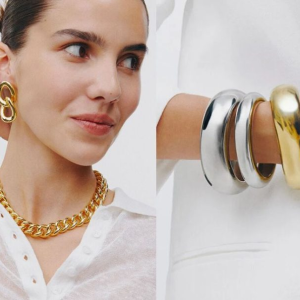
2. Jewelry Trends: Crystals Go Mainstream Fashion
Crystal jewelry in 2026 has fully crossed into mainstream accessorizing — worn by people who wouldn’t call themselves “spiritual” but want meaning-coded objects that aren’t just empty metal.
The Defining Silhouettes:
🔹 Bracelet Stacking = The Default Look
Three to five crystal bead bracelets on one wrist, mixing purposes intentionally:
- Calm + confidence→ Amethyst + Citrine
- Protection + heart-healing→ Black Tourmaline + Rose Quartz
- Mix bead sizes, add one metal cuff as anchor, mixed metals fully accepted now
🔹 Minimalist Single-Stone Pendants
The anti-stacking play. One substantial stone on a delicate chain — forces choice with purpose. Clear quartz, amethyst, or rose quartz in simple settings. Office-to-evening versatile.
🔹 Raw & Rough-Cut in Silver Settings
Polished domes aren’t going anywhere, but the organic, unpolished, visibly geologiclook signals authenticity — and it photographs better on social.
🔹 Celestial / Cosmic Motifs
Moon-phase moonstone pendants, star-accented labradorite, galaxy-themed charms. Astrology-culture + crystal-culture continue merging into one aesthetic language.
🔹 Men’s Crystal Jewelry — Finally Mainstream
Tiger eye, obsidian, onyx, lapis lazuli in beaded bracelet and pendant form. Unisex designs are the growth category — the “healing crystals are for everyone” realization is catching up to fashion.
3. Home Décor: Crystals as “Light Architecture”
This is the most visuallyexplosive category for 2026. Crystals are being integrated into interiors not as clutter-collection items but as light-manipulation tools:
| Trend | The Vibe | Where It Lives |
|---|---|---|
| Crystal clusters as sculptural objects | One museum-grade amethyst cathedral or quartz cluster as room anchor — not 40 small tumbles scattered everywhere | Living room focal point, meditation corner, office entry |
| Chandeliers roaring back | “Emotional minimalism” — one high-drama vintage/retro crystal chandelier in a clean modern room for contrast & “heritage glow” | Dining room, kitchen island, even over a freestanding tub |
| Crystal-inlaid mirrors | Frames set with baguette or crushed-crystal elements that multiply vanity light into soft prisms | Master bath vanities (“regal maximalism”) |
| Feng Shui intentional placement | Crystal trees, towers, geodes positioned for wealth/abundance corners, not random shelf-stuffing | Home office desks, entryway consoles |
The design ethos: fewer pieces, bigger presence, placed with logic.
4. The Collector Market Is Booming
One of the quiet stories of 2026: serious collector-grade specimens are appreciating. Buyers care about:
- Origin & formation quality (Brazilian amethyst cathedral vs. mystery-source)
- Untouchednatural clusters vs. acid-cleaned/heat-treated
- Auction-access to rare minerals previously only in museum circles
Crystals are being treated as alternative tangible assets the same way people treat vintage watches or rare sneakers — though obviously with very different emotional logic attached.
5. The Non-Negotiable: Ethical Sourcing
This is thedefining issue of the 2026 crystal market:
- The problem: ~majority of “cheap” crystals on Amazon/Etsy/mall kiosks come from unregulated artisanal mines with documented child labor, ecosystem destruction, and toxic dust exposure (malachite/azurite especially)
- The shift: Informed buyers now ask — Where was it mined? Was the water table protected? Were miners paid fairly? Is this dyed glass pretending to be stone?
- What to look for: Sellers who name the mine, show the rough before cutting, offer recycled/repurposed options, and don’t hide behind stock photos
Rule of thumb: If a “citrine” point costs $8 and glows neon orange, it’s heat-treated amethyst or straight-up glass. Real saturation costs more because real sourcing costs more.
The “What to Buy” Cheat Sheet
| If you… | Buy this in 2026 |
|---|---|
| Want onestone to navigate burnout / anxiety | Lepidolite bracelet or palm stone |
| Need creative momentum / confidence to act | Carnelian raw pendant or bead stack |
| Work from home & feel “off” by 3pm | Black Tourmaline near monitor + Citrine on desk |
| Want a showpiece decorative object | One collector-gradeamethyst cathedral or quartz cluster from a named source — not 20 tiny ones |
| Want everyday jewelry that works anywhere | Minimalist single-stone pendant (rose quartz / amethyst / clear quartz) on 14k or recycled silver |
| Want to start consciously | Pick one stone you’re genuinely drawn to, buy it from a seller who discloses origin, learn it well before expanding |
The Bottom Line
2026’s crystal trends are less about “what’s new” and more about growing up. The market is maturing — toward fewer-better pieces, ethical receipts, nervous-system realism, and stones treated as tools you use, not tchotchkes you hoard. The magic isn’t in having the rarest specimen on the block. It’s in that 30-second pause when you touch the stone, breathe, and remember what you’re here for. ✨
Want me to recommend a starter trio tailored to something specific you’re navigating right now? Tell me the situation and I’ll match stones + forms (tumble vs. point vs. jewelry) that actually fit your life.
Leave a Reply
Want to join the discussion?Feel free to contribute!