Crystal jewelry is becoming more and more popular among people. People in China, Japan, South Korea, the United States and other countries also have a soft spot for crystal balls, and like to place them in their homes or offices, believing that crystal balls have spirituality, can keep peace and bring wealth. However, natural crystal is not as crystal clear as it seems, and it also has flaws, so we should pay attention to it when buying jewelry. In addition, we also need to grasp the evaluation basis and purchase method of crystal, which can help us choose the crystal we like in a dazzling array of crystal jewelry.
Common imperfections of crystals
1. Hidden cracks
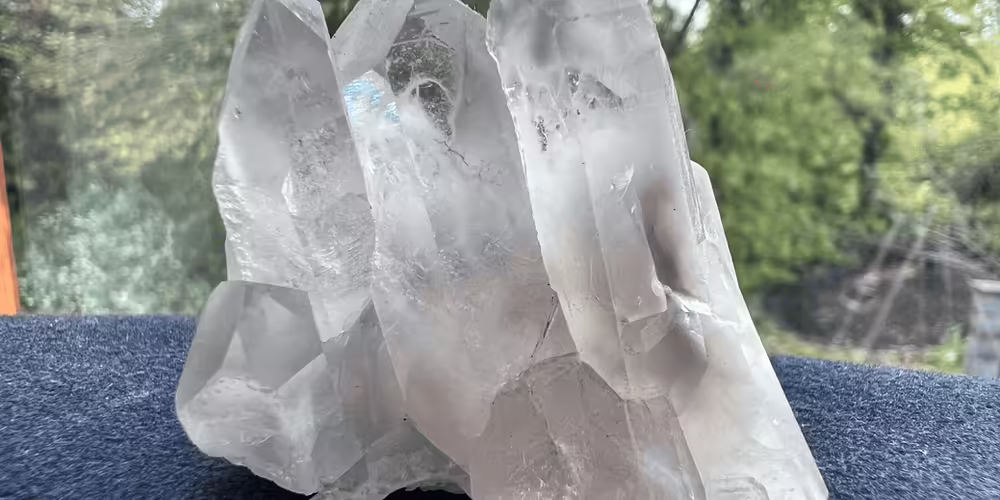
In transparent crystals, the hidden cracks are shiny flakes and sometimes have a halo effect. These cracks are some invisible cracks generated by external force during the growth of crystals, and hidden cracks are common in hibiscus stones, amethysts, white crystal balls and white crystal columns. Some cracks are later filled with substance, forming healed cracks, that is, the original cracks have grown again. This crack has a relatively small effect on the crystal.
2. Cotton, clouds or slag-like inclusions and impurities have foggy phenomena inside the transparent crystal or feel like inclusions like cotton wool and slag-like substances, and the existence of these inclusions affects the overall appearance of the crystal. There are also crystals that contain black spots or other colored patchy substances, which are not in harmony with the crystal as a whole, and are regarded as crystal impurities, and crystals with such impurities are defective.
3. Cracks
After the crystal is formed, due to external force or some man-made reason, the crystal produces large cracks or cracks, which are large and small, and the impact on the crystal is also divided into sizes.
4. Growth defects
The potholes on the surface of the crystal, some deep, some shallow, are naturally formed during the growth of the crystal, not man-made damage. The defective position was originally coated with other mineral crystals, but due to the weak binding force of the inclusions and the crystal junction, when the surface was polished, the ore body fell off, leaving a vacancy. This defect is more common on green ghosts, titanium crystals, and blonde crystals.
5. Damage
Damage refers to the damage caused by the crystal due to processing or accidental falling, collision and other reasons. It can be a breach, a pit, etc.
The basis for the evaluation of crystals
Crystals are evaluated mainly based on their color, transparency, size, clarity, special pattern and whether they have optical effects. It is better to have pure color, high concentration, and flawless interior. Amethyst is the most expensive species, followed by citrine, smoky quartz, colorless crystal and hibiscus stone. Crystals with special optical effects are more expensive.
1. Color, transparency
Generally speaking, amethyst and citrine are the more valuable varieties of crystal. The two are further graded according to the shade of their color, with the darker ones being A and the lighter ones being B. Generally, the price of darker colors is higher, but it should be not dark as the standard. There are two colors, one is the color of the crystal itself and the other is the color of the internal inclusions. The color of the crystal itself should be bright and pure, and the distribution should be uniform, not too dark or too shallow, such as Australian jade, blue chalcedony, amethyst, citrine, and its price is high. Colorless crystals contain inclusions that are brightly colored and have a high price, such as titanium crystals, green ghosts, and red rabbit fur. Amethyst is generally slightly cloudy, dark purple in color, and crystal transparent.
According to the transparency index, the more transparent the crystal, the higher the price, and the finished product processed by a good transparent crystal is crystal clear and dazzling. Crystals with high transparency can enhance the brilliance of the color, otherwise it will look dull and spiritual. Optical crystals are required to be fully transparent, free of double crystals, and free of impurities. Process crystals require transparency, less cracking, and fewer flaws. Smelted crystals are required to be transparent and can have many cracks. The value of the three decreases in turn, and smelting crystal can only be used as a raw material for smelting crystal glass. In the craft crystal, the larger crystal can be used to make crystal glasses and carve high-end handicrafts, so the price is higher.
2. Special patterns and inclusions
If the jade texture can form a beautiful pattern and pattern, its price will be high, such as the red and white ribbons in the agate are arranged regularly, forming a silk agate, and the uneven color in the jasper forms a landscape pattern, the value of the material will increase. When inclusions inside a crystal form a beautiful pattern, such as ghost crystals, landscape crystals, or needle-like inclusions arranged in bundles, they are all worth more than ordinary crystals. The more beautiful and meaningful the pattern, the better.
The value of hair crystals depends on the color, rarity and size of the hair, and the price is generally high for bright color and large lumps. The value of water urchin crystals mainly depends on the size and transparency of water urchs and crystals. If the water urchin is large and has a certain form, it can be processed into a more precious handicraft. In addition, the water in the water bladder also has a certain scientific research value, through which we can understand the composition and changes of water on the earth millions of years ago.
3. Block size
The value of the crystal is also related to the size of the block, the same color and clarity level, the larger the block, the rarer it is. Sometimes the quality level is lower, but the block is large enough, and the price may be higher than that of a high-level small crystal
4. Clarity
Colorless crystals are known for their crystal beauty, cleanliness and transparency. The colorless crystal is mainly measured by its purity, the purer and more transparent the better. Clean, flawless, and less impurities are worth more. If colorless crystals are dirty, they are of no use.
5. Texture
The fewer impurities and cracks, the better. For crystal products with good texture, there should be no star-like, cloud-like and flocculent distribution of gas-liquid inclusions or particles that make up jade. If there are cracks and spots, it is a defective product.
6. Processing technology
Crystal and its quartzite jade is a low-grade gem jade, although not as noble as diamond and ruby sapphire, but in the processing if the idea is ingenious and finely processed, it also has a high value.
The value of crystals varies greatly depending on the quality, the size of the block, the beauty and the amount of production. When encountering a good natural crystal, you must dare to start, but everyone generally wants to get a good crystal, and whether it is worth it or not depends on experience. Due to the mining and production of natural crystals, crystals without flaws are hard to come by, and pure jewelry is really rare to achieve quality comparable to synthetic crystals. In addition, due to the characteristics of the crystal, its grade will also change during the wearing process, for example, for some reason, it may gradually produce larger cracks.