Aragonite
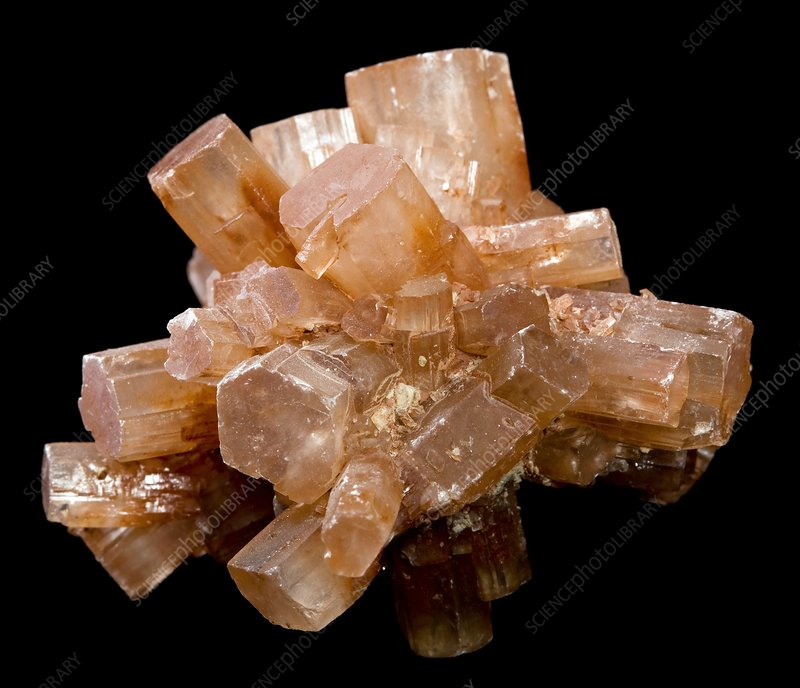
 Aragonite crystals. Aragonite is a variant of calcium carbonate, along with the mineral calcite. This sample, found in Morocco, is 4 centimetres long.
 crystals of Aragonite mineral stone isolated on white background
Aragonite is a carbonate mineral and its formula is calcium carbonate. It has the same formula as Calcite and Vaterite, but has a different crystal structure. They are tabular, prismatic or needle-like, often with steep pyramidal or chisel-shaped ends, and can form columnar or spreading aggregates. Multiple twin crystals that appear hexagonal in shape are common. Although aragonite sometimes resembles calcite, it is easily distinguished by the absence of rhombic cleavage. Samples can be white, colorless, gray, yellowish, green, blue, reddish, purple or brown. Aragonite is found in oxidized areas of ore deposits and in evaporites, hot spring deposits and caves. It is also found in some metamorphic and igneous rocks and is formed by biological and physical processes, including precipitation from marine and freshwater environments.
Name: For its first-noted occurrence in the Aragon region, Spain
Association: For its first-noted occurrence in the Aragon region, Spain
Polymorphism & Series: Trimorphous with calcite and vaterite
Mineral Group: Aragonite group
Contents
- Chemical Properties
- Aragonite Physical Properties
- Aragonite Optical Properties
- Aragonite Occurrence
- Uses of Aragonite
- Distribution
Chemical Properties
| Formula | CaCO3 |
| Common Impurities | Sr,Pb,Zn |
Aragonite Physical Properties
| Crystal habit | Orthorhombic |
| Color | Colorless to white or grey, often stained various hues by impurities, such as blue, green, red or violet; colourless in transmitted light. |
| Streak | Uncolored/white. |
| Luster | Vitreous, Resinous |
| Cleavage | Distinct/Good On {010} distinct; On {110} and {011} very indistinct. |
| Diaphaneity | Transparent, Translucent |
| Mohs Hardness | 3½ – 4 |
| Tenacity | Brittle |
| Density | 2.947 |
| Fracture | Sub-Conchoidal |
Aragonite Optical Properties
| Type | Biaxial (-) |
| 2V: | Measured: 18° to 19°, Calculated: 16° to 18° |
| RI values: | nα = 1.529 – 1.530 nβ = 1.680 – 1.682 nγ = 1.685 – 1.686 |
| Twinning | Single crystals are typically twinned cyclically on {110} producing pseudo-hexagonal aggregates of contact and penetration twins. Polysynthetic twinning produces lamellae or fine striations parallel to [100]. |
| Optic Sign | Biaxial (-) |
| Birefringence | δ = 0.156 |
| Relief | High |
| Dispersion: | weak |
Aragonite Occurrence
It turns into calcite over geological time. Primary sediment in warm marine waters such as oolites and carbonate mud, an essential clastic sedimentary component as the hard parts of the shells and skeletons of many marine micro-organisms; also from evaporite deposits; in sinter in hot springs and in stalactite in caves; characteristic of high pressure, low temperature (blueschist facies) metamorphism; as amygdullary in basalt and andesite; It is a secondary component in altered ultramafic rocks.
Aragonite is a high pressure polymorph of calcium carbonate. Therefore, it occurs in high pressure metamorphic rocks such as those formed in subduction zones.
Aragonite is metastable at low pressures near the Earth’s surface and is therefore often replaced by calcite in fossils. Aragonite older than the Carboniferous is essentially unknown. It can also be synthesized by adding a solution of calcium chloride in water-ethanol mixtures at ambient temperatures or to a sodium carbonate solution at temperatures above 60 °C (140 °F).
Uses of Aragonite
Aragonite provides essential materials for marine life and also keeps the pH of the water close to its natural level to prevent the dissolution of biogenic calcium carbonate.
Aragonite has been successfully tested for the removal of contaminants such as zinc, cobalt and lead from contaminated wastewater.
Claims that magnetic water treatment can reduce calcification by converting calcite to aragonite have been met with skepticism, but remain under investigation.
Distribution
Many localities, but fine crystals are uncommon.
- From Molina, Guadalajara Province, Spain.
- Fine crystals from Racalmuto, Cianciana, and Agrigento, Sicily, Italy.
- At Dogn´acska and Spania Dolina (Herrengrund), Slovakia.
- From Tarnowitz, Silesia, Poland.
- At ˇ the Erzberg, near Eisenerz, Styria, and from Leogang, Salzburg, Austria.
- On the Spitzberg, Hoˇrenz, near B´ılina, Czech Republic.
- From Frizington and Cleator Moor, Cumbria, England.
- Fine examples at the Touissit mine, near Oujda, and from Tazouta, near Sefrou, Morocco.
- Large crystals from Tsumeb, Namibia.
- In the USA, in caves at Bisbee, Cochise Co., Arizona; large crystals from near Lake Arthur, Chavez Co., also near Santa Rosa, Guadalupe Co., New Mexico; in the Passaic mine, Sterling Hill, Ogdensburg, Sussex Co., New Jersey