Obsidian: Properties, Uses and Virtues
Obsidian: The short version for people in a hurry
Obsidian is a unique variety of volcanic glass with a hardness of 5 to 5.5 on the Mohs scale. It is found in many parts of the world, including North and Central America, Europe and Asia. Dating back to Antiquity, obsidian is prized for its beauty and utility.
Appreciated for its aesthetic appeal and metaphysical properties, obsidian is considered to possess anchoring energy and to promote emotional healing. Its appearance varies from black to brown, gray, blue or green, sometimes with iridescent or golden reflections due to inclusions of minerals such as hematite or goethite. Varieties include snowflake, fire, apache tear, gold, silver, celestial eye (rainbow) and mahogany obsidian.
Its main imitation is manufactured glass, and obsidian can be worn as jewelry if precautions are taken, such as a protective setting.

Obsidian: Table of contents
- Obsidian: The short version for people in a hurry
- Geological formation of obsidian
- Rough Obsidian – An Amorphous Gem
- Sources – Obsidian World Presence
- History of obsidian – A Travers Les Ages
- Metaphysical properties of obsidian
- Obsidian varieties
- Obsidian color
- Durability and portability of obsidian
- Obsidian enhancements
- Synthetic obsidian
- Obsidian imitations
- Obsidian care
- Sources
Geological formation of obsidian
Obsidian is a naturally occurring form of glass derived from the fusion of silica-rich volcanic rocks such as basalt, andesite and rhyolite, which are rapidly cooled at or near the surface of erupting volcanoes.
Rough Obsidian – An Amorphous Gem
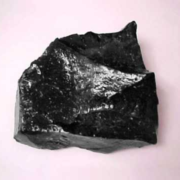
Obsidian is one of the “amorphous” gems, meaning it has no crystalline form. Unlike Quartz, for example, you won’t find well-formed crystals with smooth faces and defined angles. This gem can be found in pieces.
Sources – Obsidian World Presence
Obsidian is found in many parts of the world, particularly in the USA and Mexico. They are also found in Japan, Italy, Iceland and Indonesia. Some varieties are specifically localized to a single area.
History of obsidian – A Travers Les Ages
Prehistoric use: Obsidian’s earliest uses date back to prehistoric times, when it was cut into sharp tools such as arrowheads, knives and scrapers because of its hardness and sharpness. Ancient civilizations such as the Mesopotamians, Egyptians, Mayans and Aztecs made extensive use of obsidian for weapons, tools and ritual objects.
Use in rituals and beliefs: Over time, obsidian has become associated with religious rituals and spiritual beliefs. Many cultures believed obsidian to possess mystical and protective powers, regarding it as a sacred stone. It was often used for divination, healing and protection against negative forces.
Trade and exchange: Obsidian also played a crucial role in trade and exchange between ancient civilizations. Because of its rarity in certain regions and its value as a quality material for tools and weapons, it was often used as a medium of exchange in ancient trade networks.
Influence in art and crafts: In addition to its functional use, obsidian has also been appreciated for its aesthetic beauty and artistic qualities. It was carved into sculptures, jewelry and decorative objects, often with symbolic or religious motifs. Artisans have exploited obsidian’s natural color and unique texture to create pieces of great artistic value.
Contemporary use: Today, obsidian continues to be appreciated for its metaphysical properties, and also remains a prized material for jewelry and decorative objects, while its affordability and history make it a coveted collector’s item.
Metaphysical properties of obsidian
Recognized for its protective properties and spiritual grounding power, obsidian is said to promote mental clarity and emotional balance.
Obsidian varieties
Obsidian varieties offer a fascinating range of colors, patterns and unique properties. Here are some of the best-known varieties:
Snowflake obsidian: Snowflake obsidian is characterized by its white or gray snowflake-like inclusions, which contrast with the stone’s black or dark brown base. These inclusions are often composed of cristobalite or feldspar crystals, and create distinctive patterns that evoke snowy landscapes.
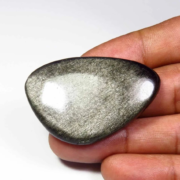
Golden or silver obsidian: Golden or silver obsidian is a remarkable variety, with color nuances ranging from golden to bronze and silver. It owes its shimmering hue to the presence of gas bubble inclusions, typical of amorphous materials.
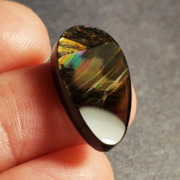
Celestial eye obsidian: Celestial eye obsidian, also known as rainbow obsidian or iris, is a multicolored variety that displays a shimmering palette of colors in circles, ranging from violet to green, blue and gold. These colors are often created by inclusions of crystals or iridescence that diffuse light in a unique way, giving each piece a vibrant, luminous appearance.
Fire obsidian: Fire obsidian is a variety displaying a palette of reds, oranges and golds, usually caused by microparticles of hematite. This palette gives it the appearance of bright fire. It is actually very similar to celestial eye obsidian, but has a finer layer of inclusions.
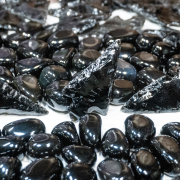
Apache Tears obsidian: Apache Tears obsidian is a black or dark brown variety named after the legend that Apache warriors wept tears from this stone when in mourning. It is often translucent, sometimes with golden or red highlights.
Mahogany obsidian: Mahogany obsidian is a richly colored variety, ranging from reddish brown to deep purple. It owes its name to its mahogany-like color. This variety is often appreciated for its warm color and natural patterns, which can evoke wooded landscapes or twilight skies.
Obsidian color
Obsidian varies in color from deep black to brown, gray, blue and green. The reflections will be violet, blue, golden to silver, green, orange to red, depending on the impurities and minerals present.
Durability and portability of obsidian
With an average hardness of 5 to 5.5 on the Mohs scale, obsidian is suitable for use in jewelry and decorative objects, but requires careful handling to avoid damage.
Obsidian enhancements
Natural obsidian is very rarely enhanced or treated.
Synthetic obsidian
Manufactured glass is present on the market and difficult to spot without gemmological equipment. It’s best to turn to specialists, and avoid the big sales platforms of all kinds.
Obsidian imitations
Obsidian is usually imitated by manufactured glass.
Obsidian care
To preserve its beauty, clean obsidian regularly with lukewarm water and a soft cloth, avoiding harsh chemicals. Remember to use protective settings when wearing it as jewelry, and keep it away from other stones that could damage it.
Sources
Costa Laurent-Jacques, L’Obsidienne, un témoin d’échanges en Méditerranée préhistorique, 2007.
International Association For Obsidian Studies.
Mark Cartwright, Obsidian in Mesoamerica, 2022 via World History Encyclopedia.