What is Jedi Spinel?
With a trade name sure to attract attention, Jedi spinel has become a very popular gemstone. Jeffrey Bergman of 8th Dimension Gems tells how these spinels got their name and explains their properties. He also discusses how they’re mined, shows us many beautiful examples of Jedi spinel jewelry, and the efforts of the AIGS to develop grading standards for Jedi spinels.
Spinel Gemstones
Historically sourced from Tajikistan, Afghanistan, and Sri Lanka, and more recently from Vietnam and Tanzania, spinels have a long history as jewelry stones. However, over the past several decades, the vivid pink and red spinels of Namya (also known as Nanyazeik) and Mogok’s Man Sin mine in Myanmar (formerly known as Burma) have fueled the increasing demand for spinels. Although Namya and Man Sin are renowned for their vivid red and pinkish red spinels, these neon colors can be found in any spinel-producing areas in Myanmar, Vietnam, and Tanzania.
How did Jedi Spinel Get its Trade Name?
In the early 2000s, renowned field gemologist Vincent Pardieu was shown some exceptional spinels in Myanmar by gemstone dealer Yuval “Hemi” Englisher of Gemcal Co., Ltd., Bangkok. Pardieu was stunned by their vivid pinkish red hues that exhibited a neon-like glow he had never encountered in spinels of any origin. Playing off the immense popularity of the Star Wars film series, he began calling these glowing hot pink to red gems “Jedi” spinel, as they were untouched by the “dark side of the Force.” This au courant nickname quickly caught on in the gem trade and contributed significantly to spinel’s current popularity.
Spinel’s Physical Properties
Historically, peoples in Europe, Asia, and the Middle East classified red spinels as “balas rubies,” a type of ruby prized for its exceptional size, especially by royalty. Modern mineralogy scientifically distinguished spinel as a mineral species distinct from corundum (ruby) in 1783.
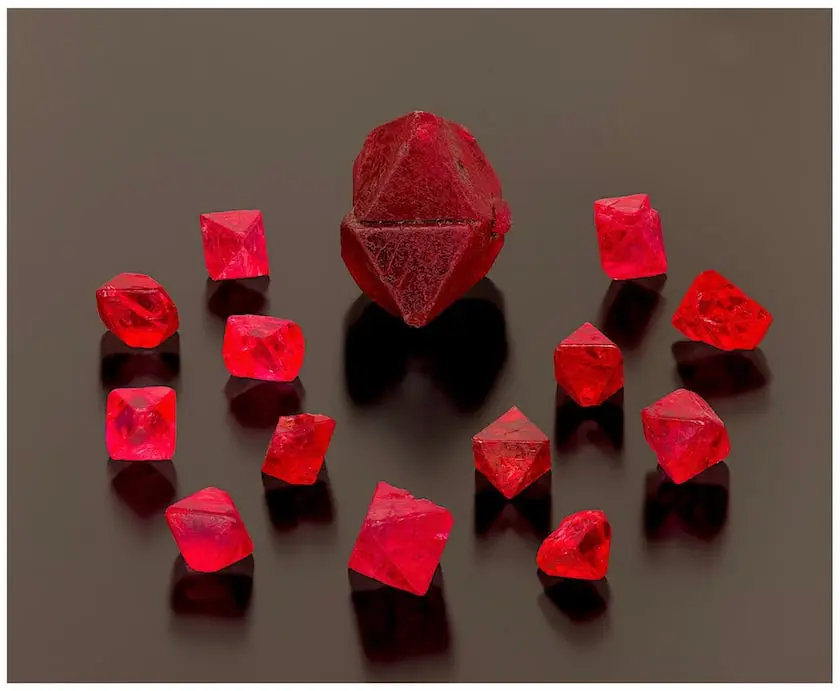
Spinel is a magnesium aluminum oxide with a chemical formula of MgAl2O4 and an isometric or cubic crystal structure. Crystals typically have an octahedral shape, which resembles two pyramids base-to-base, no cleavage, and a conchoidal fracture.
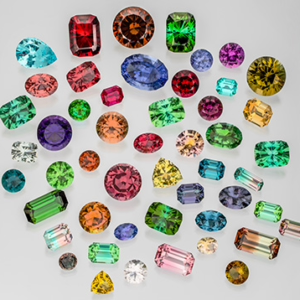
Spinel has a hardness of 7.5-8, a specific gravity of 3.6-4.1, and a single refractive index of 1.719. Trace element chromophores of iron (Fe), chromium (Cr), vanadium (V), manganese (Mn), and cobalt (Co) can produce a range of natural colors in spinels, including black, brown, red, pink, orange, blue, purple, and, very rarely, green and yellow. Ultraviolet fluorescence ranges from inert to weak or strong red or, very infrequently, green.
What Causes Red Color in Jedi Spinel?
Chromium is the coloring agent responsible for red color and fluorescence in spinels, including Jedi spinels.
What Causes the “Dark Side” in Red Spinel?
Trace amounts of iron darken the red color in spinels and reduce their fluorescence. The more iron in a spinel, the darker and less fluorescent it will be. Thus, iron induces the “dark side of the Force” in spinels, so to speak.
What Inclusions are Found in Spinels?
The inclusions found within spinels reflect the geological environment in which spinels form. Crystal inclusions of minerals such as calcite and apatite are quite common. Many spinels contain well-formed negative octahedral crystals (cavities shaped like octahedral crystals) that, in turn, contain other minerals, liquids, or both.
What are Burmese Nat Thwe Spinel Crystals?
The mines of Mogok and Namya are renowned for producing euhedral spinel crystals. Euhedral crystals have well-developed faces that appear faceted, although they occur naturally. The local trade expression for these euhedral spinel crystals is nat thwe, which means “polished by the spirits.”