Rhodochrosite
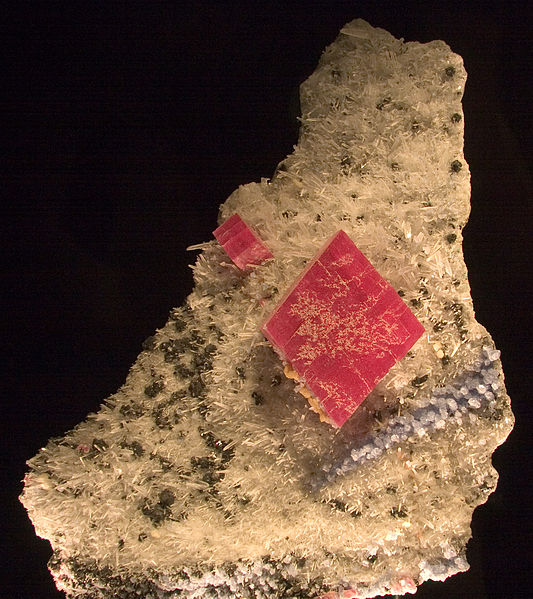
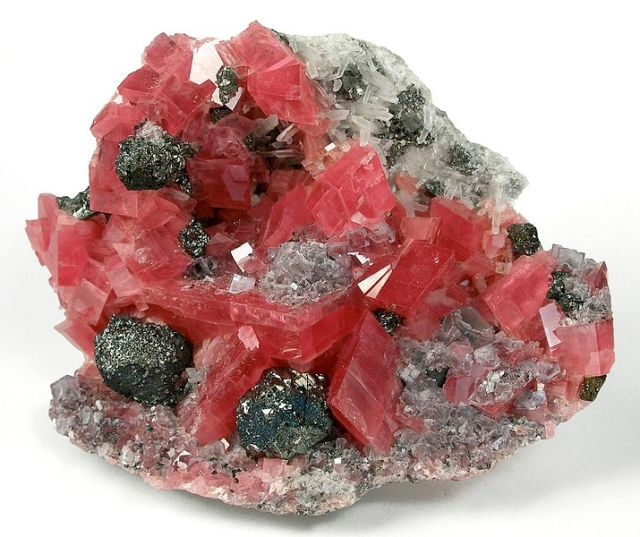
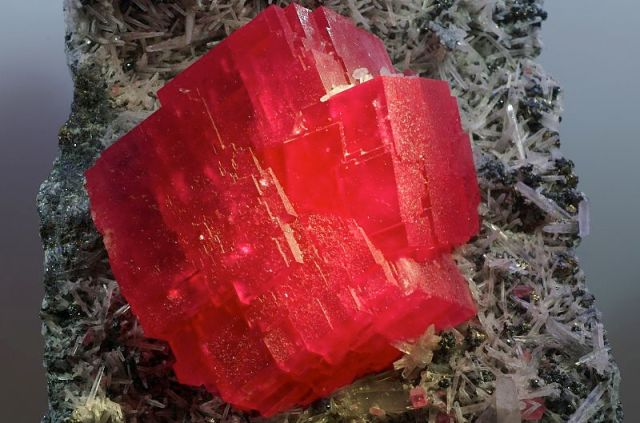
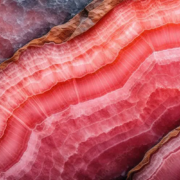
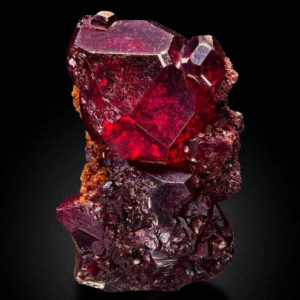
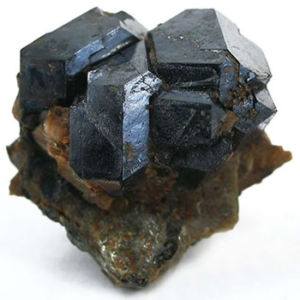
Rhodochrosite is a carbonate mineral with formula: MnCO3. It has a classic rose-pink color, but specimens can also be brown or gray. It forms dogtooth or rhombohedral crystals like calcite, but it may also occur in stalactitic, granular, nodular, botryoidal, and massive habits. Rhodochrosite is found in hydrothermal ore veins with sphalerite, galena, fluorite, and manganese oxides. It also occurs in metamorphic deposits and as a secondary mineral in sedimentary manganese deposits. Abundant at Butte, Montana, and other localities, rhodochrosite is sometimes mined as an ore of manganese.
Name: Derived from two Greek words meaning rose and color, in allusion to its rose-pink color.
Association: Calcite, siderite, dolomite, fluorite, barite, quartz, pyrite, tetrahedrite, sphalerite, hubnerite (hydrothermal); rhodonite, garnet, alabandite, hausmannite (metamorphic).
Polymorphism & Series: Forms two series, with calcite and with siderite.
Mineral Group: Calcite group.
Rhodochrosite Composition: Manganese carbonate, MnC03. MnO = 61.7 percent, C02 = 38.3 percent. Iron is usually present, replacing a part of the manganese, and some analyses report calcium, magnesium, zinc.
Diagnostic Features: Told usually by its pink color, rhombohedral cleavage, and hardness (4). Distinguished by its hardness from rhodonite (MnSi03, H. = 5, 5-6, 5).
Crystallography: Rhombohedral; scalenohedral. Only rarely in crystals of the unit rhombohedron; frequently with curved faces. Usually cleavable massive; granular to compact.
Environment: Hydrothermal veins associated with Silver, Copper, and lead sulfides; may also be found in some pegmatites.
Contents
- Chemical Properties
- Rhodochrosite Physical Properties
- Rhodochrosite Optical Properties
- Occurrence of Rhodochrosite
- Rhodochrosite Uses Area
- Distribution
- References
Chemical Properties
| Chemical Classification | Carbonate minerals |
| Formula | MnCO3 |
| Common Impurities | Fe,Ca,Mg,Zn,Co,Cd |
Rhodochrosite Physical Properties
| Color | Pink, rose, red, yellowish-grey, brown, white, gray; colourless to pale rose in transmitted light. |
| Streak | White |
| Luster | Vitreous, Pearly |
| Cleavage | Perfect On {1011}. |
| Diaphaneity | Transparent, Translucent |
| Mohs Hardness | 3,4 – 4 |
| Crystal System | Trigonal |
| Tenacity | Brittle |
| Density | 3.7 g/cm3 (Measured) 3.7 g/cm3 (Calculated) |
| Fracture | Irregular/Uneven, Conchoidal |
| Parting | On {0112} at times. |
| Crystal habit | Rhombohedral and scalenohedral crystals; also commonly bladed, columnar, stalactitic, botryoidal, granular or massive |
Rhodochrosite Optical Properties
| Color / Pleochroism | Weak |
| RI values: | nω = 1.814 – 1.816 nε = 1.596 – 1.598 |
| Twinning | On {1012} as contact and lamellar |
| Optic Sign | Uniaxial (-) |
| Birefringence | δ = 0.218 |
| Relief | High |
Occurrence of Rhodochrosite
A primary mineral in low- to moderate-temperature hydrothermal veins; in metamorphic deposits; common in carbonatites; authigenic and secondary in sediments; uncommon in granite pegmatites.
Rhodochrosite is a comparatively rare mineral, occurring in veins with ores of silver, lead, and copper, and with other manganese minerals.
Rhodochrosite Uses Area
- Its primary use is as ore of manganese, which is a key part of minimal effort treated steel definitions and certain aluminum amalgams.
- Quality banded examples are frequently utilized for decorative stones and jewelry. Because of its being moderately delicate, and having flawless cleavage, it is exceptionally hard to cut, and along these lines seldom discovered faceted in gems.
- Manganese carbonate is incredibly ruinous to the amalgamation procedure utilized in the convergence of silver minerals, and were frequently disposed of on the mine dump.
Distribution
Numerous localities; only a few for fine specimens are listed.
- From Cavnic (Kapnikbanya) and Herja (Kisbanya), Baia Mare (Nagyb´anya) district, Romania.
- In the Wolf mine, near Herdorf, Westphalia, Germany.
- In Russia, from the Vuoriyarvi carbonatite complex and the Kovdor massif, Kola Peninsula.
- Large twinned crystals at Mont Saint-Hilaire, Quebec, Canada.
- In the USA, from the Emma mine, Butte, Silver Bow Co., Montana; in Colorado, at many localities, as fine large crystals in the Home Sweet Home mine, Alma, Park Co., from the Climax mine, Lake Co., in the Sunnyside mine, near Silverton, San Juan Co., and the Mountain Monarch mine, Ouray Co.
- In Mexico, from Cananea, Sonora, and Santa Eulalia, Chihuahua. Large crystals from the Huallapon mine, Pasto Bueno, Ancash Department, and in the Uchuc-Chacua deposit, Cajatambo Province, Peru.
- In Province, Peru.
- A large deposit of ornamental banded material at the Capillitas mine, San Luis, Catamarca Province, Argentina.
- Exceptional crystals from the Hotazel and N’Chwaning mines, near Kuruman, Cape Province, South Africa.
- From the Inakuraishi and Yakumo mines, Hokkaido, Japan.
References
- Bonewitz, R. (2012). Rocks and minerals. 2nd ed. London: DK Publishing.
- Dana, J. D. (1864). Manual of Mineralogy… Wiley.
- Handbookofmineralogy.org. (2019). Handbook of Mineralogy. [online] Available at: http://www.handbookofmineralogy.org [Accessed 4 Mar. 2019].
- Mindat.org. (2019): Mineral information, data and localities.. [online] Available at: https://www.mindat.org/ [Accessed. 2019].