Nepheline

Nepheline – USGS Mineral Specimens
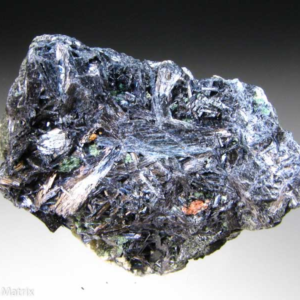
Nepheline is the most common feldspathoid mineral in the world, its name from the Greek word nephele, which means “cloud” a reference to the fact that the mineral becomes cloudy or milky in strong acids. Specimens are usually white in color, often with a yellowish or grayish tint. They can also be colorless, gray, yellow, or red-brown. Nepheline is generally massive. Crystals usually occur as hexagonal prisms, although they can exhibit a variety of prism and pyramid shapes. Nepheline also forms large, tabular phenocrysts in igneous rocks. This rock-forming mineral is found in iron- and magnesiumrich igneous rocks with perovskite, spinel and olivine. It also occurs in intermediate igneous rocks with aegirine and augite and in some volcanic and metamorphic rocks.
Name: Nepheline is derived from a Greek word meaning a cloud, because when immersed in acid the mineral becomes cloudy. Eleolite is derived from the Greek word for oil, in allusion to its greasy luster.
Composition: Sodium-potassium aluminum silicate, (Na,K)- (Al,Si)20 4 . The amount of potassium present is usually low. The percentages of oxides in the artificial compound NaAlSi04 are: Na20 = 21.8, A120 3 = 35.9, Si02 = 42.3.
Morphology: Stout prisms, granular, compact, massive
Association: Potassic feldspar, plagioclase, sodic pyroxenes, sodic amphiboles, leucite, olivine, augite, diopside.
Mineral Group: Feldspathoid minerals
Alteration: Easily alters to various other minerals, such as zeolites, sodalite, muscovite, kaolin
Diagnostic Features. Characterized in massive varieties by its greasy luster. Distinguished from quartz by inferior hardness and from feldspar by gelatinizing in acid.
Contents
- Chemical Properties
- Nepheline Physical Properties
- Nepheline Optical Properties
- Occurrence of Nepheline
- Uses Area
- Distribution
- References
Chemical Properties
| Chemical Classification | Tectosilicate, feldspathoid |
| Formula | (Na,K)AlSiO4 |
| Common Impurities | Mg,Ca,H2O |
Nepheline Physical Properties
| Color | White, grey, yellowish |
| Crystal habit | Massive granular to prismatic |
| Luster | Vitreous, Greasy |
| Cleavage | Poor/Indistinct Poor on {1010}, {0001} |
| Diaphaneity | Transparent, Opaque |
| Mohs Hardness | 5,5 – 6 |
| Crystal System | Hexagonal |
| Tenacity | Brittle |
| Density | 2.55 – 2.66 g/cm3 (Measured) 2.64 g/cm3 (Calculated) |
| Fracture | Sub-Conchoidal |
Nepheline Optical Properties

Nepheline under the microscope. Picture source url=
https://www.ucl.ac.uk/~ucfbrxs/MoreMinerals/Nepheline.html
| Crystal Habit | Anhedral masses, or (less often) prismatic with square or hexagonal cross section |
| Color / Pleochroism | Colorless in thin section (non-pleochroic) |
| 2V: | N/A |
| RI values: | nω = 1.529 – 1.546 nε = 1.526 – 1.542 |
| Twinning | On {1010}, {3365}, {1122} |
| Optic Sign | Uniaxial (-) |
| Birefringence | δ = 0.003 – 0.004 |
| Relief | Low |
| Dispersion: | N/A |
Occurrence of Nepheline
Nepheline is rarely found except in igneous rocks. It occurs in some recent lavas as glassy crystals, such as are found in the lavas of Vesuvius. The massive or coarsely crystalline variety is found in the older rocks and is called eleolite. Phonolite, nepheline syenite, and nepheline basalt are important rocks in which nepheline is an essential constituent. It is found only in rocks whose magmas contained insufficient silica to combine with soda to form feldspar. Only in exceptional circumstances, therefore, is it found in rocks that contain quartz. The largest known mass of nepheline rocks is found on the Kola Peninsula, U.S.S.R. Locally in these rocks nepheline is associated with apatite. Extensive masses of nepheline rocks are found in Norway and South Africa. In crystals in the lavas of Vesuvius. In the United States nepheline, both massive and in crystals, is found at Litchfield, Maine, associated with cancrinite. Found near Magnet Cove, Arkansas, and Beemerville, New Jersey. Common in the syenites of the Bancroft region of Ontario, Canada, where there are pegmatites with rather large masses of nearly pure nepheline.
Uses Area
Recently iron-free nepheline, because of its high alumina content, has been used in place of feldspar in the glass industry. Most of the commercial nepheline comes from Ontario. The Russians report that nepheline, produced as a by-product of apatite mining on the Kola Peninsula, is used in fifteen different industries including ceramics, leather, textile, wood, rubber, and oil.
Distribution
Wide-spread; only a few prominent localities can be mentioned.
- In Italy, at Vesuvius and Monte Somma, Campania.
- On the Katzenbuckel, Odenwald, Baden-WÄurttemberg, Germany.
- In the Langesundsfjord area, Norway. In Portugal, from the Sierra de Monchique.
- Around the Tunugdliark Fjord and on the Kangerdluarssuk Plateau, in the Ilmaussaq intrusion, southern Greenland.
- In the Lovozero massif, Kola Peninsula, Russia.
- From the Nyiragongo volcano, Kivu Province, Congo (Zaire).
- In the USA, at Litcheld, Kennebec Co., Maine; near Magnet Cove, Hot Spring Co., and on Granite Mountain, near Little Rock, Pulaski Co., Arkansas; from Iron Hill, Gunnison Co., Colorado; at Point of Rocks, Colfax Co., New Mexico.
- In Canada, in the Bancroft district, Ontario, especially large crystals from Davis Hill; from Mont Saint-Hilaire, Quebec