Colored Stones: All About Cultured Pearls
The captivating beauty of colored stones has fascinated humans for thousands of years. Among all gemstones, one stands out for its unique origin and exquisite allure — the pearl. Unlike most gems, formed beneath the surface of the earth or in a laboratory, pearls are created by living organisms. And the reason pearls are available in abundance today is because the vast majority are “cultured” in pearl farms, guided by human assistance.

Cultured Pearls
This remarkable modern gemstone owes its existence to the ingenuity and perseverance of Kokichi Mikimoto, a Japanese entrepreneur and inventor. With a twinkle in his eye and a passion for pearls, Mikimoto embarked on a quest to unlock nature’s secrets. Little did he know that his journey would lead to the birth of cultured pearls, forever changing the jewelry world.

Kokichi Mikimoto, born in 1858, was the first person to successfully culture pearls. His passion for pearls began at a young age when he witnessed the decline of natural pearl production due to overfishing and pollution. Determined to find a solution, Mikimoto dedicated his life to perfecting the technique of pearl cultivation. After years of experimentation, he successfully produced the world’s first cultured pearl in 1893, revolutionizing the pearl industry and forever changing the way we perceive these precious gems.

Formation and properties
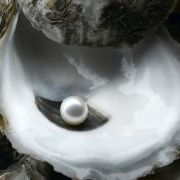
The formation of a cultured pearl begins with the introduction of a foreign object such as a bead into the soft tissue of an oyster. In response to this irritant, the oyster secretes layers of nacre to coat the foreign object, a combination of calcium carbonate and other organic shimmering substances. Over time, these luminous layers build up, ultimately forming a lustrous pearl. The thickness and quality of the nacre layers determine the durability and value of a pearl.

Chemically, pearls are composed of aragonite, a crystalline form of calcium carbonate, which gives them their characteristic appearance. The nacreous layers of a pearl are arranged in a concentric pattern, reflecting light, and creating “iridescence,” the mesmerizing aesthetic that pearls are renowned for. A cultured pearl’s iridescence is a result of the interference of light waves as they pass through the layers of calcium carbonate and conchiolin. As light interacts with the concentric microstructures within the layers, they interfere with each other, causing some wavelengths to cancel out and others to intensify. Among all gemstones, the iridescence of pearls is unique.

Appearance and colors
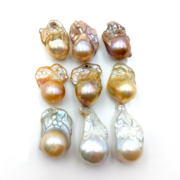
Cultured pearls come in a wide range of colors, shapes, and sizes, making them a versatile gemstone for jewelry. The most common colors include white, cream, and pink, but pearls can also be found in shades of silver, blue, green, and even black. The color of a pearl is influenced by various factors, such as the type of oyster, the water quality, and the presence of trace elements.

The shape of a cultured pearl can vary from perfectly round to irregularly shaped, with “baroque” pearls showcasing unique and artistic forms. The size of a pearl is measured in millimeters and can range from tiny seed pearls to large, statement-making gems. The combination of color, shape, and size allows for endless possibilities in creating stunning pearl jewelry.

History, myths, and legends
For thousands of years before Mikimoto spawned the cultured pearl revolution humans were enchanted by natural pearls, harvested in the wild. In ancient Greece they were associated with love and marriage while in ancient Rome they symbolized wealth and power. In Chinese culture, pearls were believed to bring good luck and to provide protection from evil spirits. From a favored adornment of queens in Egypt to tales of mermaids gifting pearls to sailors in the western world, these luminous gems have held a special place in different cultures and mythologies, stirring the imagination for generations.
One of the most famous legends surrounding pearls is a story involving Cleopatra. According to the tale, Cleopatra wagered Marc Antony that she could host the most expensive dinner in history. To win the bet she dissolved a large pearl in a glass of wine and drank it, demonstrating her immense wealth and extravagance.

Countries of origin
Natural pearls were originally sourced from the Persian Gulf, the Red Sea, and the coasts of India and Sri Lanka. However, with the advent of cultured pearls, production has expanded to various countries around the world. Today, the leading producers of cultured pearls include Japan, China, Australia, and Tahiti, among others.
Japan, the birthplace of cultured pearls, continues to be renowned for its high-quality Akoya pearls. China, on the other hand, has become a major player in freshwater pearl production, offering a wide range of colors and shapes. Australia is known for its lustrous South Sea pearls, prized for their large size and natural golden hues. Tahiti, famous for its black pearls, produces some of the most sought-after and exotic cultured pearls in the world.

Cultured pearls today
In recent years, the popularity of cultured pearls has soared, with celebrities and fashion icons embracing their timeless elegance. From classic pearl necklaces to modern and edgy designs, pearls have become a staple in the world of jewelry and personal fashion.

Furthermore, the cultured pearl industry has made significant strides in sustainability and environmental responsibility. Pearl farms employ techniques to minimize the impact on marine ecosystems and ensure the well-being of the oysters. This commitment to sustainability has led to the rise of eco-friendly pearl jewelry, appealing to conscious consumers who value ethical practices.
Today the cultured pearl is a gemstone that combines natural beauty with human ingenuity and social responsibility. From its humble beginnings in the hands of Kokichi Mikimoto to widespread production today, the cultured pearl continues to captivate and enchant people. Beyond their beauty, pearls continue to hold symbolic significance in various cultures, representing purity, wisdom, and prosperity. Spanning a range of diverse colors, shapes, and sizes there are endless possibilities for exquisite and inventive incorporation into jewelry. Whether valued for their historical significance or admired in modern fashion, pearls continue to be a timeless symbol of elegance and sophistication.